01
How to Choose the Right Jewelry
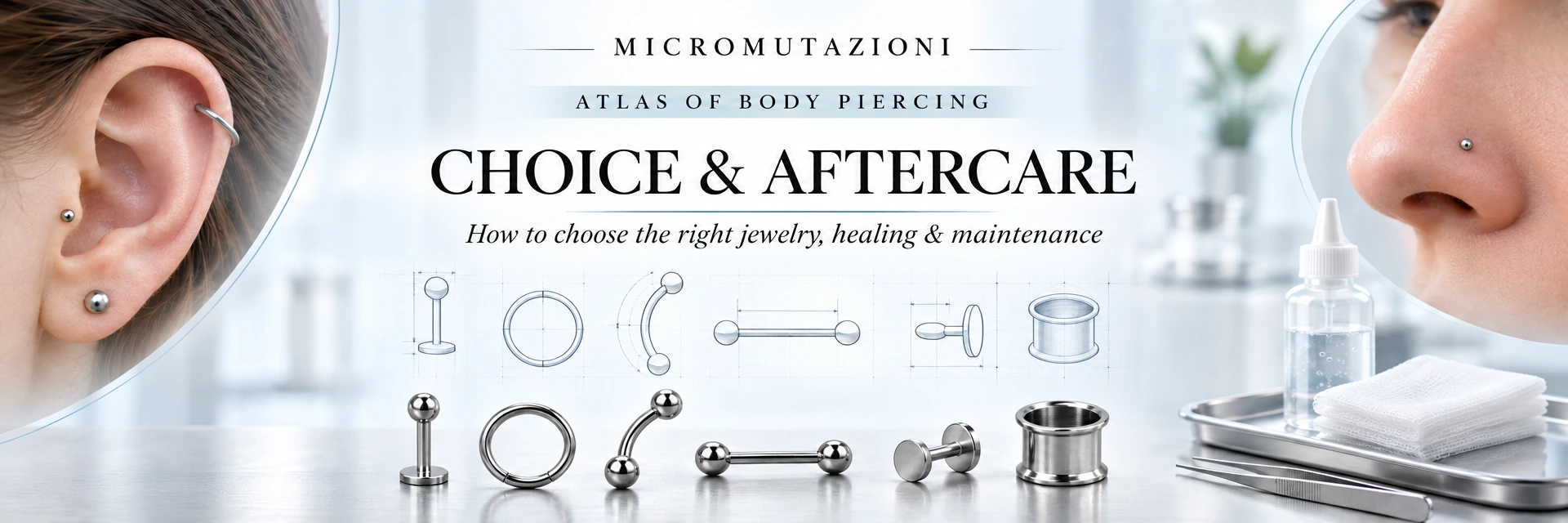
Piercing jewelry should not be chosen based on color and design alone. Anatomy, sizing, and material are central aspects. The bar thickness, often expressed in gauge, must be compatible with the piercing. The length of a labret or barbell and the inner diameter of a ring influence how the jewelry interacts with the tissue. A component that is too tight can create pressure, while an excessively long one can increase snagging and movement. The closure and threading must also be compatible with the system.
Not all materials are suitable for every stage of a piercing. Jewelry for a fresh piercing should not be evaluated using the same criteria as an ornament for a fully healed lobe. For fresh piercings, sizing and materials must be determined with a qualified piercer based on anatomy and technical documentation.
02
Aftercare, healing, and maintenance
Healing is a biological process influenced by the anatomical area, individual conditions, and external factors. A piercing may appear stable externally before the tissues have completed internal healing. Professional guidelines generally prioritize gentle cleaning and minimizing trauma. The Association of Professional Piercers recommends, among other things, sterile saline solution for cleaning and advises against unnecessarily rotating jewelry during healing. Healing times vary according to placement and the individual; they cannot be accurately determined by the name of the piercing alone.
Increasing pain, significant swelling, abnormal discharge, or persistent symptoms require medical evaluation. The Atlas is intended for informational and cultural purposes and does not replace the advice of a healthcare professional nor an individual anatomical assessment.