01
Piercing Jewelry Materials
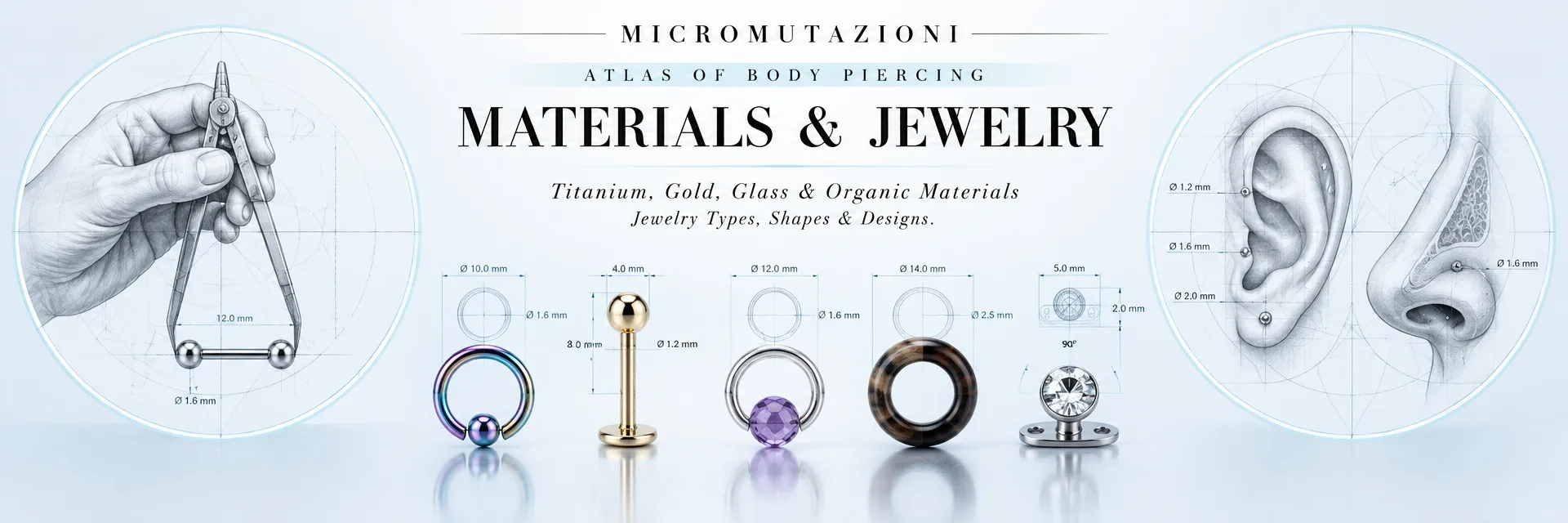
The history of contemporary piercing is also a history of materials. Jewelry designed to be worn in a body piercing requires careful attention to composition, surface finish, sizing, and closure mechanisms, not just aesthetics.
Titanium
Titanium is essential in professional body jewelry due to its lightweight nature, mechanical properties, and the excellent biocompatibility of specific alloys. Generic commercial claims must be distinguished from materials backed by documentation certifying compliance with relevant standards, such as ASTM F136 or ASTM F67. The mere label G23 is not sufficient proof of compliance with an implant-grade standard. Titanium is used in labrets, barbells, rings, clickers, and many other systems.
Steel
Stainless steel has historically been widespread in body jewelry. Alloys such as 316L and 316LVM are frequently cited, yet suitability and intended use depend on actual composition, manufacturing quality, and documented standards. Steel compliant with ASTM F138 should not be confused with any piece of jewelry generically described as surgical steel.
Gold
Gold represents one of the most refined expressions of contemporary body jewelry. Yellow, white, and rose gold creations can feature diamonds, sapphires, and other gemstones set with precision techniques. Professional guidelines for specific applications recommend 14K or 18K solid gold with appropriate composition and surface finish. Solid gold, gold plating, and gold-tone finishes are not equivalent.
Niobium
Niobium is a metal used in select piercing jewelry, also valued for its ability to be colored through anodization. It represents a distinct category separate from titanium and steel.
Borosilicate Glass
Borosilicate glass and specific technical glasses are used in plugs, tunnels, retainers, and other styles designed for specialized applications. Clarity, craftsmanship, surface finish quality, and glass composition dictate both functional and aesthetic performance.
Natural Stone
Agate, onyx, quartz, amethyst, and numerous other stones are crafted into ornamental jewelry, particularly for ear gauges. Each material features its own mineral structure, hardness, and unique characteristics. Natural stones should not be indiscriminately recommended for fresh piercings.
Wood, Horn, and Organic Materials
Wood and horn have a rich history in body adornment and are used in plugs, weights, and handcrafted jewelry. Their properties differ significantly from metals: porosity, finishes, and maintenance require careful attention. Materials intended for healed stretched piercings are not automatically suitable for initial use.
Recommended navigation path: Titanium Jewelry · Gold Body Jewelry · Steel Jewelry · Niobium Jewelry · Glass Plugs · Stone Plugs · Organic Jewelry.
02
Main Shapes of Piercing Jewelry
Anatomical placement is only one of the selection criteria. Body jewelry includes systems with diverse functions and shapes.
Labret and Flat Back
The labret is a piece of jewelry with a flat rear end, used in numerous facial and ear placements when appropriate. It can accommodate different mounting systems and interchangeable decorative ends.
Straight Barbell and Curved Barbell
The Straight Barbell consists of a straight bar with ends. The Curved Barbell features a curvature designed for specific anatomical configurations. The term Bananabell is commonly associated with curved jewelry, especially for navel piercings.
Captive Bead Ring, Segment Ring and Clicker
The Captive Bead Ring holds a bead in place through the geometry and tension of the system: it is one of the historic shapes of modern piercing. The Segment Ring features a removable or openable section; the Clicker generally utilizes a hinged closure.
Circular Barbell
The Circular Barbell, often called a horseshoe, features an open curved bar and two ends. It is associated with the septum, but can also be used in other compatible configurations.
Threadless, Internal Threading and External Threading
Threadless systems use a secure fit without traditional threading. Internally threaded jewelry features threads inside the bar; externally threaded utilizes a different system. Dimensions are not necessarily compatible across products and manufacturers.
Plugs, Tunnels, Spirals and Weights
These categories are primarily intended for stretched piercings. Solid plugs, open tunnels, decorative spirals, and ear weights also differ in geometry, mass, and weight distribution.