Hardness
Resistance to scratching. The Mohs scale ranks minerals from 1 to 10, but the intervals are not uniform: diamond and corundum are close in number, yet vastly different in actual hardness.
CRYSTALS, RITUALS & HUMAN BELIEFS
From the sacred stones of ancient civilisations to contemporary crystals: minerals, jewellery, rituals, chakras and tools for meditation.
Discover the crystals in our studioThere is a moment in the history of almost every civilisation when a stone ceases to be merely matter. It is chosen for its colour, kept for its rarity, fashioned into an ornament, passed down as an amulet. An engraved carnelian, a polished jade, a fragment of lapis lazuli, a quartz crystal: tiny objects capable of travelling across centuries, places and languages. Mineralogy tells us how they formed; archaeology shows us who worked them; the history of religions helps us understand why they were considered precious, protective or sacred.
The world of crystals encompasses all this and much more. It encompasses the geometry of minerals and the light passing through quartz, jewellery, representations of the subtle body in India, Reiki as it emerged in twentieth-century Japan, contemporary crystal healing, energy wands and pendulums used in divination rituals. These are different histories, often intersecting over time, which deserve to be told without being confused with one another.
This section of Micromutazioni explores the relationship between the mineral world and human imagination, making room both for scientific knowledge and for the personal and symbolic value that some people attribute to crystals. A gemstone's physical properties are measurable; its spiritual qualities belong to traditions and cultural interpretations. Understanding the difference does not diminish the fascination of stones: it makes their history more interesting.
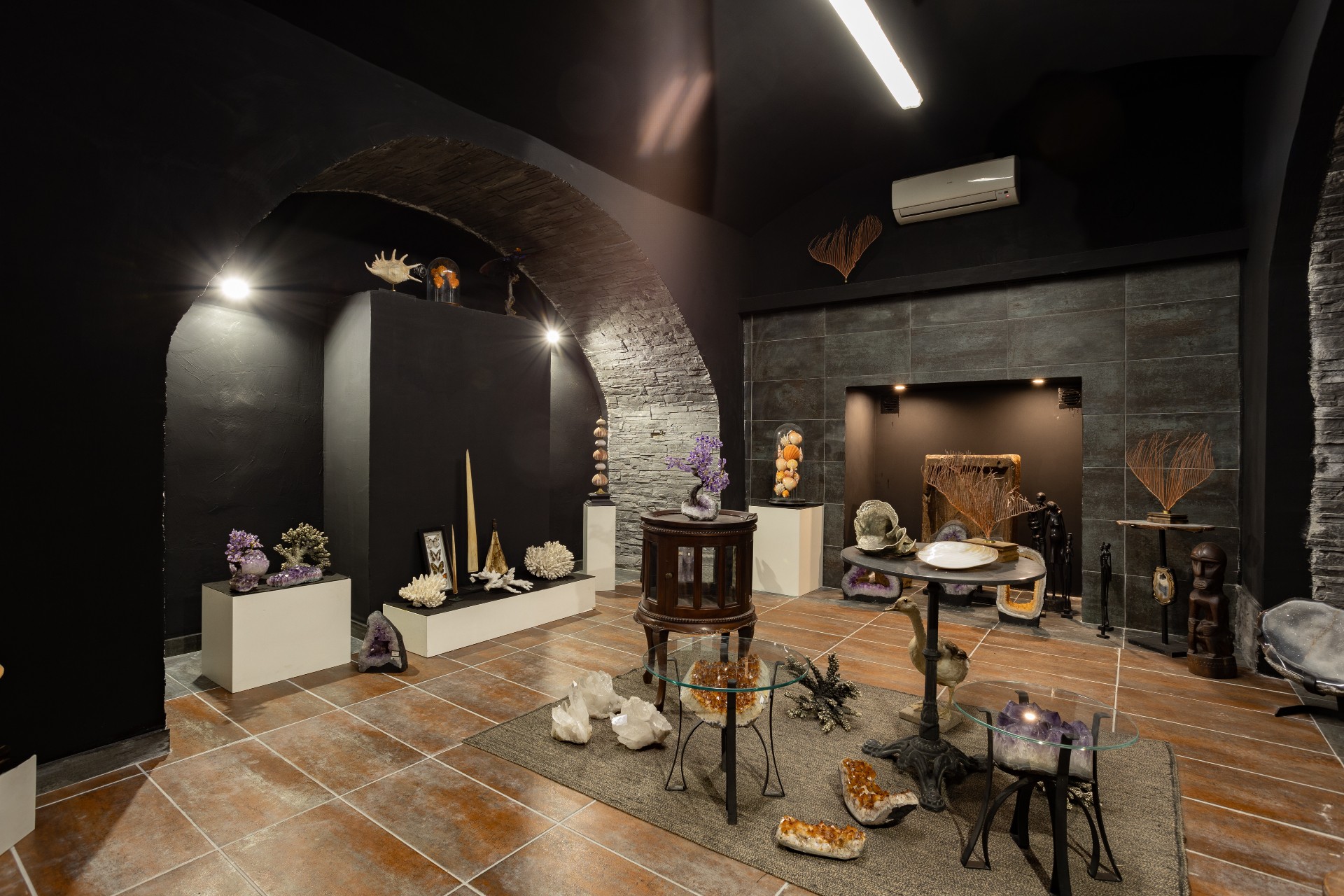
Micromutazioni is not only a studio devoted to piercing and body art. At Via Broggia 14, Naples, among displays of jewellery and natural history objects, visitors can also discover crystals, minerals, polished stones and jewellery with natural gemstones. The studio also houses a space dedicated to the world of divination, with symbolic objects and tools that engage with the traditions explored on this page.
The connection is no coincidence. A piece of jewellery can be an ornament, but also an object of memory, identity or personal meaning. Natural stones share with body art a long-standing relationship with the ways people choose to represent themselves, recognise themselves and express their sensibilities.
Come and discover the selection available at the studio. Collections and availability may change: if you are interested in a specific object, it is best to contact us before visiting.
On one side is Micromutazioni, a physical space for jewellery, body culture and encounters with objects; on the other is Mineral Art Gallery, a specialist catalogue of natural crystals, collectible minerals, stone jewellery, carvings and ornamental tools. This page provides knowledge; when visitors wish to explore a broader collection, they will find relevant links to Mineral Art Gallery. The aim is not to replace the studio experience with an external website, but to offer two complementary ways of approaching the same material world.
Across the eight chapters, you will encounter three distinct languages: history, when a practice or symbol is documented by sources; mineralogy, when discussing composition, hardness, structure and origin; and spiritual tradition, when describing beliefs, interpretations and practices. In the latter case, associations are presented as cultural meanings, not as proven medical properties.
OUR EXPERIENCE
For Micromutazioni these subjects are not a passing trend: we have practised and studied them for over thirty years, with the same strong cultural interest that runs through the whole project. This page grew out of that journey and the wish to clarify histories and differences, without turning experience into absolute truth.
Part of the shop in Via Broggia is dedicated to minerals, jewellery with gems and natural stones, and holistic objects. Choosing in person allows you to observe forms, inclusions, weight and light: a tangible encounter with the material, before any interpretation.
Via Broggia 14, 80135 Naples, Italy
Tuesday–Saturday, 11:00–19:00
The history of the relationship between human beings and minerals does not begin with energy wands or chakras. It begins much earlier, when certain stones were selected rather than simply gathered. An intense colour, a surface that can be polished, a material that withstands time: natural qualities that encouraged the creation of ornaments, tools, amulets, seals and ritual objects. Sometimes these functions overlapped. A gemstone could be both a mark of prestige and a symbol of protection.
The traditions of the past do not form a single system of ancient crystal healing. They are different experiences, rooted in different societies. The value of a Roman amethyst, a Chinese jade and a Māori pounamu cannot be reduced to a generic word, “energy”. To understand them, we need to look at how they were worked, used and passed down.
In ancient Mesopotamia, cylinder seals were objects of extraordinary importance. Rolled across still-soft clay, they impressed mythological scenes, divine figures or identifying marks. Some were made from lapis lazuli, carnelian and other hard stones. They could identify their owner, validate documents and, in some cases, also serve as amulets. The stone was not merely something to look at: it played a part in social relationships and everyday activities. The Metropolitan Museum's collections document cylinder seals from the Akkadian and Babylonian periods, including examples in lapis lazuli.
Egyptian amulets are among the clearest examples of the fusion of material, colour, form and belief. Carnelian, jasper, lapis lazuli, turquoise, feldspars and glass pastes could become small wedjat eyes, scarabs and other figures intended to protect or accompany their owner. In funerary rituals, the object formed part of a complex vision of life after death. Its meaning did not depend on the mineral substance alone: its shape, inscription and colour, and the words spoken during the ritual, also mattered. To speak of “sacred Egyptian stones” without remembering these elements would be to lose the most interesting part of the story.
In Neolithic China, cultures such as Liangzhu, active approximately between 3200 and 2000 BCE, produced remarkably complex jade objects, particularly in nephrite. Among the best-known forms are bi discs and cong tubes. Working the material was demanding, because jade is tough and difficult to shape. The surviving objects attest to a highly significant ceremonial role, although the precise original interpretation of each form is not always known. Here, symbolic value also arises from the investment of time, skill and culture required to transform the stone.
In India, gemstones have a long history in jewellery, royalty, texts and astrological practices. The Navaratna system brings together nine gemstones symbolically associated with the nine celestial bodies of the Indian astrological tradition. It is not the same system as the seven chakras, and confusing them would be historically inaccurate. Historical bracelets and jewellery preserved in museums also demonstrate this distinction. Keeping traditions separate matters: it reveals the cultural richness of minerals and helps us understand how the interpretation of a stone changes with its context.
In Greek and Roman culture, the study of stones moved between natural observation, ancient medicine, curiosity and belief. Theophrastus's treatise On Stones is one of the foundational texts in the history of mineralogy. Centuries later, Pliny the Elder would devote extensive sections of his Naturalis historia to gemstones. Some qualities attributed to stones belonged to the medicine and symbolic thought of their time; other observations concerned colour, hardness, working techniques and provenance. Stones were a field in which material knowledge and imagination continually met.
Medieval lapidaries collected and transmitted information about stones, including medicinal, moral and protective virtues that are not recognised by scientific medicine today. They were not all alike: there were scholarly works, religious texts, compilations of classical traditions and vernacular treatises. Hildegard of Bingen and other figures are often mentioned in this context. It is useful to present these texts as evidence of the culture of their period, not as manuals of therapeutic efficacy.
In Maya cultures, jadeite, particularly in green shades, held great ceremonial and funerary prestige. In Aotearoa/New Zealand, pounamu is a taonga, a culturally treasured possession: a personal ornament, a material for tools and an object that can express genealogy, authority and intergenerational transmission. Its meaning should not automatically be translated into the New Age categories of the “heart stone”. Indigenous traditions have their own terms, histories and contexts, which deserve recognition.
From the nineteenth century onwards, European esotericism, theosophy, interest in Asian philosophies and subsequent twentieth-century movements contributed to new interpretations of crystals. The New Age movement popularised systems of correspondences between minerals, colours, emotions and chakras. Today's crystal healing is therefore a contemporary construction that sometimes draws on older ideas, reinterpreting them. This does not make it meaningless to those who practise it: it places it accurately within history.
Narrative transition: there is no straight line from the stone that protects in myth to the stone that accompanies contemporary meditation. There is a branching history of encounters between different worlds, and it is precisely this complexity that makes crystals an inexhaustible subject.
01 / BEFORE MEANING
A crystal has an ordered, repeating internal structure. A mineral is a naturally occurring, generally inorganic substance with a characteristic composition and structure. A gem, by contrast, is a material that human culture considers beautiful, rare and durable enough to shape, wear or keep.
Not every gem is a single crystal: lapis lazuli is a rock, amber is fossilised resin, and pearl and coral are organic in origin. “Natural”, “synthetic” and “imitation” also mean different things: a synthetic material reproduces the essential properties of its natural counterpart in a laboratory; an imitation copies only its appearance.
Composition, hardness, toughness and stability therefore come before any attributed properties. They determine whether a stone scratches, breaks, fades or tolerates water. Beauty may suggest a meaning; mineralogy tells us how to care for the object.
Resistance to scratching. The Mohs scale ranks minerals from 1 to 10, but the intervals are not uniform: diamond and corundum are close in number, yet vastly different in actual hardness.
Resistance to fracture and impact. A hard stone can be brittle; jade, though less hard than diamond, is celebrated precisely for its toughness.
How a material responds to light, heat, water and chemicals. Amethyst and other stones can fade; selenite and porous materials require entirely different precautions.
ANCIENT EGYPT
Shape, colour, material, inscriptions and ritual gestures all contributed to meaning. Amulets were worn, placed on the body and included among grave goods: they were not simply lucky stones, but objects embedded in a specific religious worldview.
GREECE AND ROME
Amethyst comes from the Greek amethystos, “not drunk”, because it was believed to protect against intoxication. Ancient names, however, do not always refer to the same mineral species recognised today.
INDIA
Texts such as the Ratnapariksa connect stones, deities, planets and days. The Navaratna tradition arranges nine gems into a cosmological map: it is not the same as the modern pairing of seven crystals with seven chakras.
CHINA, MESOAMERICA, OCEANIA
Jade has taken on very different ritual, political, aesthetic and genealogical roles. In China it has been associated with power and morality; among the Olmec and Maya, with divine and royal imagery; for Māori, certain ornaments preserve ancestry and belonging.
MIDDLE AGES AND RENAISSANCE
Pliny, Isidore, Marbode, Hildegard and other authors described the medical and magical virtues of stones. Those texts belong to the history of medicine and the cultural understanding of nature: they tell us what people believed, not whether a treatment worked.
20TH–21ST CENTURIES
During the 1970s and 1980s, modern crystal healing brought together crystals, chakras, the aura and intention. Correspondences vary from author to author: there is no universal dictionary of stones, but a living, debated repertoire.
Today, the term crystal healing refers to a heterogeneous range of practices that attribute a symbolic or energetic role to minerals, crystals and gemstones. Some practitioners choose a stone for its colour; others follow correspondences between minerals and chakras; others arrange crystals in a space or use them during meditation. There is no single, codified and universally shared method. The modern use of stones for well-being developed chiefly within the context of alternative spirituality and the twentieth-century New Age movement.
Crystal healing should not be confused with mineralogy. Mineralogy describes the nature of stones through verifiable data: chemical composition, structure, hardness, density, optical properties, origin and geological transformations. Crystal healing, by contrast, attributes spiritual, emotional or ritual meanings that can vary between schools and individuals. Accurate information keeps these two levels separate.
Many people keep a crystal on their desk, bedside table or in a space at home dedicated to meditation. Its role can be very simple: to become an object to observe, hold, associate with an intention or with a moment of quiet reflection. The transparency of quartz, the purple of amethyst or the banding of malachite can invite observation and contemplation. An object does not necessarily have to “emit” something to hold emotional value or help create a personal ritual.
A simple contemplative practice might involve sitting somewhere quiet, holding a crystal in your hand or simply placing it in front of you, observing its shape and breathing slowly. When attention wanders, it is brought back to the sensations of breathing and the presence of the object. In this case, the crystal is a tangible aid to concentration, not a medical therapy. Meditation and mindfulness practices are the subject of scientific studies, but any benefits they may offer cannot automatically be attributed to the mineral used.
In contemporary tradition, the choice may depend on colour, appearance, personal feeling or a symbolic association. Rose quartz is often chosen for matters of affection; carnelian for creativity and initiative; amethyst for contemplation and stillness; clear quartz for clarity; black tourmaline for images of protection and stability. These are widespread conventions, not verifiable intrinsic properties. The same stones may receive different interpretations in different books and schools.
There is also a less-discussed but equally important criterion: you should like the stone. Observing its surfaces, inclusions, crystal growth and shades is a form of direct knowledge. An amethyst cluster can be fascinating even without knowing its symbolic meanings. A labradorite pendant changes appearance when rotated because its internal structure produces real optical effects, not because the energy of the person wearing it changes.
Common practices include small personal altars, geometric stone arrangements known as crystal grids, selections organised by colour and collections of crystals placed near a meditation area. The geometries may have artistic or symbolic meaning. There is, however, no evidence that a particular arrangement circulates therapeutic energies or produces biological changes in the body. Presenting them as ritual, historical or aesthetic compositions is more accurate and more interesting.
A stone can hold a memory, mark an intention, be chosen as a beautiful object or serve a ritual purpose within a spiritual practice. There is no reliable scientific evidence that crystals cure diseases, correct psychological or biological imbalances or replace therapy. It is important not to use the word “healing” in a clinical sense to describe crystal-healing products. If a subjective experience feels pleasant or reassuring, that feeling can be acknowledged without attributing nonexistent medical efficacy to the stone.
For those curious about natural materials, Mineral Art Gallery offers the opportunity to explore minerals, quartz, amethyst and other species, with photographs, origins and characteristics.
There is no single protocol. In many contemporary sessions, the person remains clothed, lies down and agrees on an intention with the practitioner. Stones are held in the hands, placed on the body or arranged around it; breathing, guided meditation, sound or geometric arrangements called grids are sometimes added.
The experience may feel spiritual, meditative or simply like a time set aside for rest. Its subjective value is real as an experience; it does not, however, demonstrate a physical energy in the stone or a specific therapeutic effect.
A theme is chosen to spend time with: stillness, listening, a change, a memory. It gives attention a direction; it is not a diagnosis.
The stone is chosen for its attributed symbolism, colour, shape or personal appeal. The connection with the object may matter more than a list of supposed properties.
Some people place crystals at points associated with the chakras; others hold them or keep them near their meditation space. Methods vary between schools and practitioners.
Silence, breathing and stillness create a pause. You can note what emerges without turning every sensation into evidence or an answer.
A controlled study in 2025 found no specific effect of crystals beyond placebo: reductions in anxiety occurred among those who already believed in their effectiveness, whether they received the genuine stone or the placebo. Expectation, context and attention help us interpret the experience without denying or exaggerating it.
In Sanskrit, cakra means “wheel” or “disc”. Within various religious, tantric and yogic traditions of India, the term has been used to describe centres or points in the so-called subtle body. These representations do not correspond to the anatomical description of organs or glands: they belong to ritual and contemplative practices and to different philosophical systems. There is no single list of chakras that can be attributed indiscriminately to all Indian traditions. Over the centuries, systems differing in number and position have developed.
The now very common representation of seven chakras arranged vertically from the pelvis to the crown of the head, each characterised by a rainbow colour and a particular gemstone, is largely the result of modern Western reinterpretations. Nineteenth- and twentieth-century theosophical sources, together with later New Age literature, helped establish this system. Researcher Kurt Leland has reconstructed its history in Rainbow Body: A History of the Western Chakra System from Blavatsky to Brennan. This is a useful clarification because it allows us to appreciate the contemporary image without presenting it as an unchanged chart from ancient India.
Muladhara, the root chakra. Usually placed at the base of the spine in modern representations, it is associated with the colour red and ideas of stability, grounding and security. Frequently linked stones include red jasper, garnet and hematite. The connection between an individual gemstone and the chakra varies from one school to another.
Svadhisthana, the sacral chakra. Generally represented by the colour orange, it is symbolically linked to creativity, sensitivity and one's relationship with emotions. Carnelian and orange calcite are among the gemstones most often mentioned in modern accounts.
Manipura, the solar plexus. Yellow is the most common colour in contemporary charts. It symbolises personal will, initiative and confidence. Citrine and tiger's eye are often paired with it. Citrine quartz is a genuine variety of quartz, but it should be remembered that much of the material on the market is heat-treated amethyst.
Anahata, the heart centre. Associated with green, and sometimes also pink, it represents affection, compassion and openness to relationships in contemporary interpretations. The gemstones most frequently mentioned are green aventurine and rose quartz. This choice does not imply any documented effect on the heart as a physical organ.
Vishuddha, the throat centre. It is normally represented in pale or light blue and associated with expression, listening and communication. Aquamarine, blue chalcedony and sodalite are frequent examples in modern lists of correspondences.
Ajna, the so-called third eye. Often represented in indigo or deep blue, it is symbolically linked to intuition, imagination and inner observation. Lapis lazuli, sodalite or amethyst are associated with it, depending on the school.
Sahasrara, the crown chakra. Usually placed near the crown of the head and represented in violet or white, it is associated with transcendence and spirituality. The minerals most often mentioned are amethyst, clear quartz and sometimes selenite.
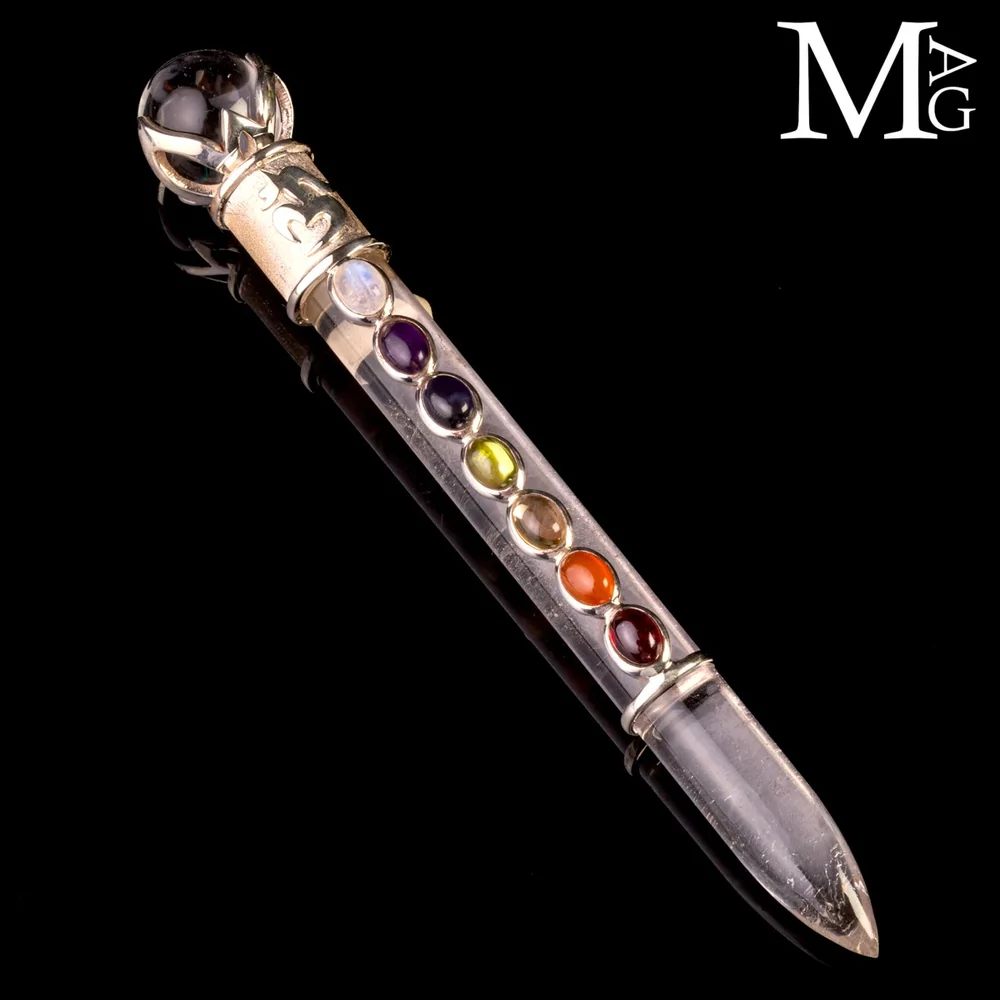
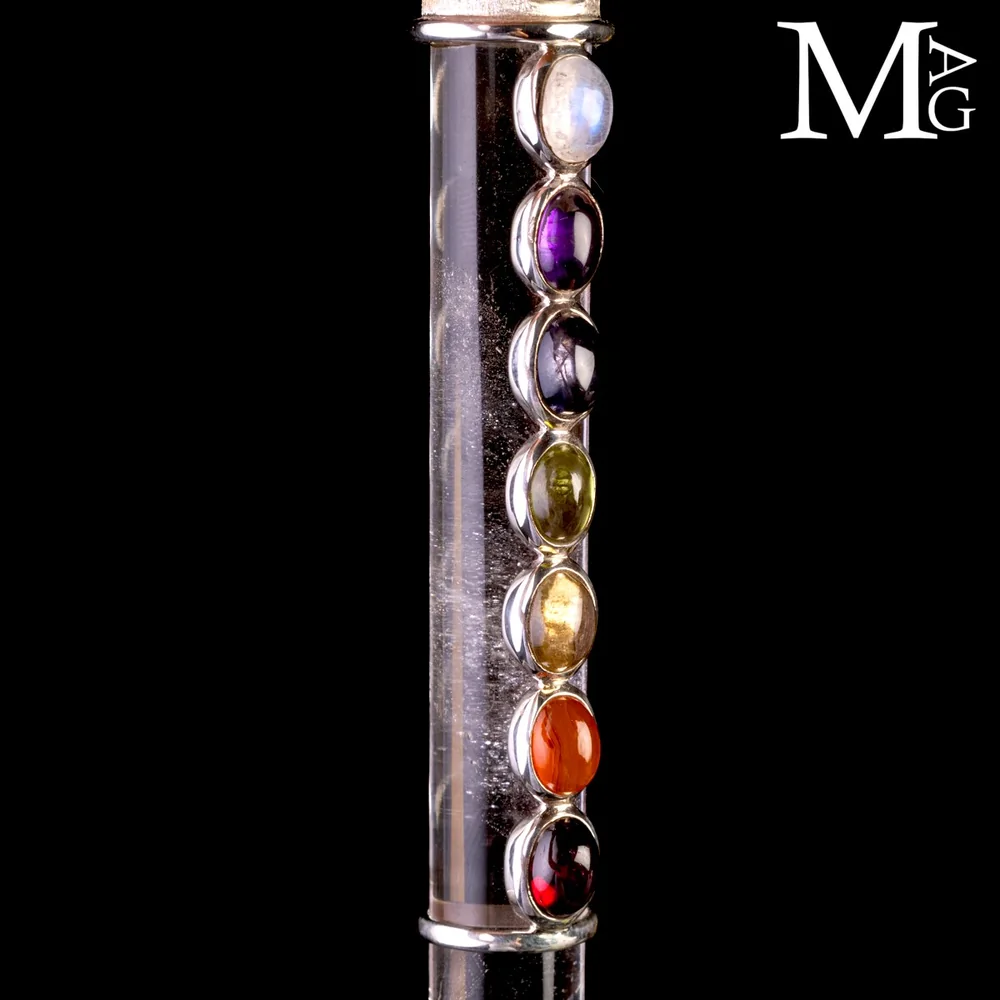
For many people, colour correspondences are a way to organise a gemstone collection and guide a meditation. A selection of seven cabochons aligned along a wand, for example, can visually represent the chakras through colour. Here, the choice of materials conveys a contemporary symbolism: red, orange, yellow, green, light blue, blue and violet create an upward progression that is easily recognisable and particularly suited to ornamental craftsmanship.
It is not, however, accurate to deduce the mineral species of each cabochon from colour alone. Different gemstones can have similar shades, and often only a gemmological examination can identify them with certainty. Product descriptions should state the stone's name only if it has been confirmed.
Chakras can appear in pendants, bracelets, spheres, wands and ritual compositions. Wearing a seven-colour piece of jewellery does not automatically change the body or one's health: it can mean choosing a personal symbol, remembering a contemplative principle or appreciating an ornamental composition. Those who use these images to meditate can focus their attention on a colour, connect it with their breathing and observe their sensations without expecting medical effects.
Base of the spine, perineal region
Root; four-petalled lotus, earth element.
Stability, security and belonging.
Lower abdomen and pelvic region
One’s own centre; six petals, water element.
Emotion, pleasure and creativity.
Navel and solar plexus region
City of the jewel; ten petals, fire element.
Will, action and confidence.
Centre of the chest
Unstruck sound; twelve petals, air element.
Relationship, compassion and reciprocity.
Throat
Purification; sixteen petals, space or ether element.
Expression, speech and listening.
Between the eyebrows
Command; two petals, associated with the mental dimension and inner guidance.
Attention, intuition and vision.
Crown of the head
Thousand-petalled lotus, distinct from the six lower centres.
Awareness, connection and transcendence.
Contemporary associations can provide a language for meditation, not for diagnosing “blockages”. Chakras are no substitute for anatomy or medical or psychological assessment.
Reiki is a spiritual practice that originated in early twentieth-century Japan. Its development is traditionally associated with Mikao Usui (1865–1926), who promoted the method known as Usui Reiki Ryōhō in the early 1920s. Many biographies recount a spiritual experience on Mount Kurama in 1922, but historical evidence must be distinguished from narratives transmitted later through the schools. The image of a Reiki unchanged for thousands of years does not correspond to the documentation of the modern method.
Reiki emerged in a Japanese cultural context in which ethical disciplines, contemplative practices and ideas about personal well-being intersected. The term is commonly interpreted through the characters rei and ki, which have received different and not always equivalent translations. A cautious description speaks of a spiritual method based on the use of the hands and a traditional conception of vital energy, not of a physical field demonstrated by science.
In contemporary Reiki practices, the practitioner may gently place their hands on the person or hold them a short distance from the body. The setting is often peaceful, with attention to breathing and stillness. In the terminology used within the schools, the practice can also take the form of self-treatment. Touch requires consent, respect for the individual and clarity about what is being offered.
The method does not necessarily require crystals, coloured chakras, wands or pendulums. Combining Reiki and gemstones is common in some contemporary circles, but it should be presented as a modern integration rather than the only authentic way to practise Reiki.
A central part of Reiki tradition consists of the five precepts often known as Gokai. Introduced by the phrase “just for today”, they encourage people not to indulge in anger, not to be ruled by worry, to cultivate gratitude, to devote themselves diligently to their work and to be kind to others. Translations and formulations can differ between schools. The ethical core is nevertheless recognisable: paying attention to everyday behaviour, rather than merely seeking an exceptional experience.
This aspect offers a natural bridge to meditation. Some people may choose objects such as a polished stone or a quartz sphere as reminders of an intention or as points of visual focus, but the meaning of the practice does not depend on possessing a particular material.
During the twentieth century, Reiki spread from Japan to other countries through teachers and practitioners, including Chujiro Hayashi and Hawayo Takata, who were particularly important to its reception in the West. International circulation also brought new interpretations, schools and vocabularies. Today, “Reiki” can refer to different experiences: for this reason, historical accounts should specify which tradition or lineage is being discussed.
According to the US National Center for Complementary and Integrative Health, the available research has not clearly demonstrated Reiki's effectiveness for specific health purposes, and there is no scientific evidence for the hypothetical energy field said to underpin it. This finding does not prevent discussion of its religious, contemplative or cultural meaning, but it rules out any promise of medical treatment on this page.
Micromutazioni presents Reiki as a chapter in spiritual culture, not as a healthcare service or a session that can be booked at the studio. Any future communication about activities actually offered will require separate approval.
Modern Reiki is associated with Mikao Usui and Japan in the 1920s. Chūjirō Hayashi developed the practice further; Hawayo Takata, who trained with him, played a decisive role in its spread through Hawaii, North America and later Europe. It is not a single tradition that has stood still: lineages and schools have transformed its techniques and language.
During a session, the practitioner places their hands lightly on the person’s clothed body, or just above it. Practitioners speak of life energy and support for the body’s natural response; scientifically, the existence of this energy field has not been demonstrated.
The precepts invite the cultivation of everyday attitudes: they are not simply words to repeat, but an ethical and contemplative discipline.
Gasshō and other attention practices prepare the way for listening; techniques vary between lineages and teachers.
Work with the hands can be practised on oneself or another person, using light touch or no contact.
Some lineages introduce them at later levels; they do not take an identical form in every school.
A rite of transmission from teacher to student marks entry into the practice and takes different forms across Reiki traditions.
A crystal does not form because it possesses a meaning, but because particular chemical and physical conditions allow atoms to organise themselves into an ordered structure. Temperature, pressure, fluid composition, available space and growth times combine to generate very different forms. Quartz can grow in hexagonal prisms, gather in geodes or occur in microcrystalline masses; gypsum can form large transparent crystals; garnet can develop dodecahedral geometries. Mineralogy offers a precise language for describing this variety.
The word “gemstone”, by contrast, denotes a material chosen for its beauty, durability or rarity and used in jewellery or ornamental objects. Not all gemstones are minerals, and not all minerals are worked as gemstones: lapis lazuli, for example, is a rock composed of several minerals, while amber is a fossil resin. This distinction is useful both for collectors and for those buying a pendant or a sphere.
Colour alone is rarely enough. A green material might be malachite, aventurine, serpentine, jade, coloured glass or something else; a purple gemstone might belong to different species. Correct identification also considers hardness, density, refractive index, pleochroism, inclusions, structure and other diagnostic features, using appropriate instruments and methods. Some gemstones undergo heating, dyeing, impregnation or irradiation treatments: these interventions must be distinguished from the mineral's natural properties when they affect its commercial description.
Quartz, SiO₂, crystallises in the trigonal system and has a hardness of 7 on the Mohs scale. The perfectly transparent, colourless variety is called rock crystal. Amethyst is the purple variety; citrine displays yellow or orange shades; smoky quartz is distinguished by brown or grey colours; rose quartz often occurs in semitransparent pink masses. Agate and chalcedony, by contrast, belong to the microcrystalline forms of silica. Colour differences depend on crystal defects, impurities, inclusions and specific geological processes that vary according to the variety.
This family lends itself to two readings. Physically, it is a material with documented optical and mechanical characteristics, also used in technology thanks to the piezoelectricity of crystalline quartz. Symbolically, many crystal-healing manuals associate clear quartz with clarity and concentration, amethyst with stillness, rose quartz with affection and citrine with vitality. Spiritual associations do not derive from chemical composition and are not proven therapeutic effects.
Tourmaline is not a single species but a group of complex borosilicates. Its range of colours includes deep blacks, greens, pinks, reds and multicoloured crystals. Commercial terms such as pink tourmaline and rubellite must be used correctly according to colour, species and gemmological context. Some crystals display very pronounced colour zoning: so-called “watermelon tourmaline”, for example, can combine green and pink zones. In modern esoteric vocabularies, black tourmaline is often associated with protection, while pink tourmaline is linked to sensitivity and affection. These are symbolic readings, not physical shields against radiation or external influences.
The beauty of many stones comes from their interaction with light: adularescence in moonstone, labradorescence in some feldspars, iridescence in certain opals, silky lustre in fibrous aggregates and fluorescence in some minerals. These phenomena can be observed, described and sometimes measured. Showing a macro photograph and explaining the optical phenomenon can be more engaging than a list of alleged powers.
Some minerals should be handled with care: gypsum and selenite are soft, malachite contains copper, cinnabar contains mercury, and other species may contain toxic components. It is therefore important to avoid recipes for elixirs, crystal-infused drinking water or powders to ingest. Cleaning methods vary by species: no single treatment is suitable for every stone.
A crystal cluster, a sphere and an individual crystal are not interchangeable. Surface quality, structure, inclusions, documented provenance, any working and the state of preservation all affect aesthetic and collectible value. Even imperfect symmetry can tell the story of growth. The website should show authentic photographs of the minerals, without inventing deposits or declaring species that have not been identified.
Those wishing to move from reading to observing actual specimens can explore the natural quartz collection at Mineral Art Gallery. Extended profiles of the main species follow in the gemstone directory.
04 / ATLAS OF STONES
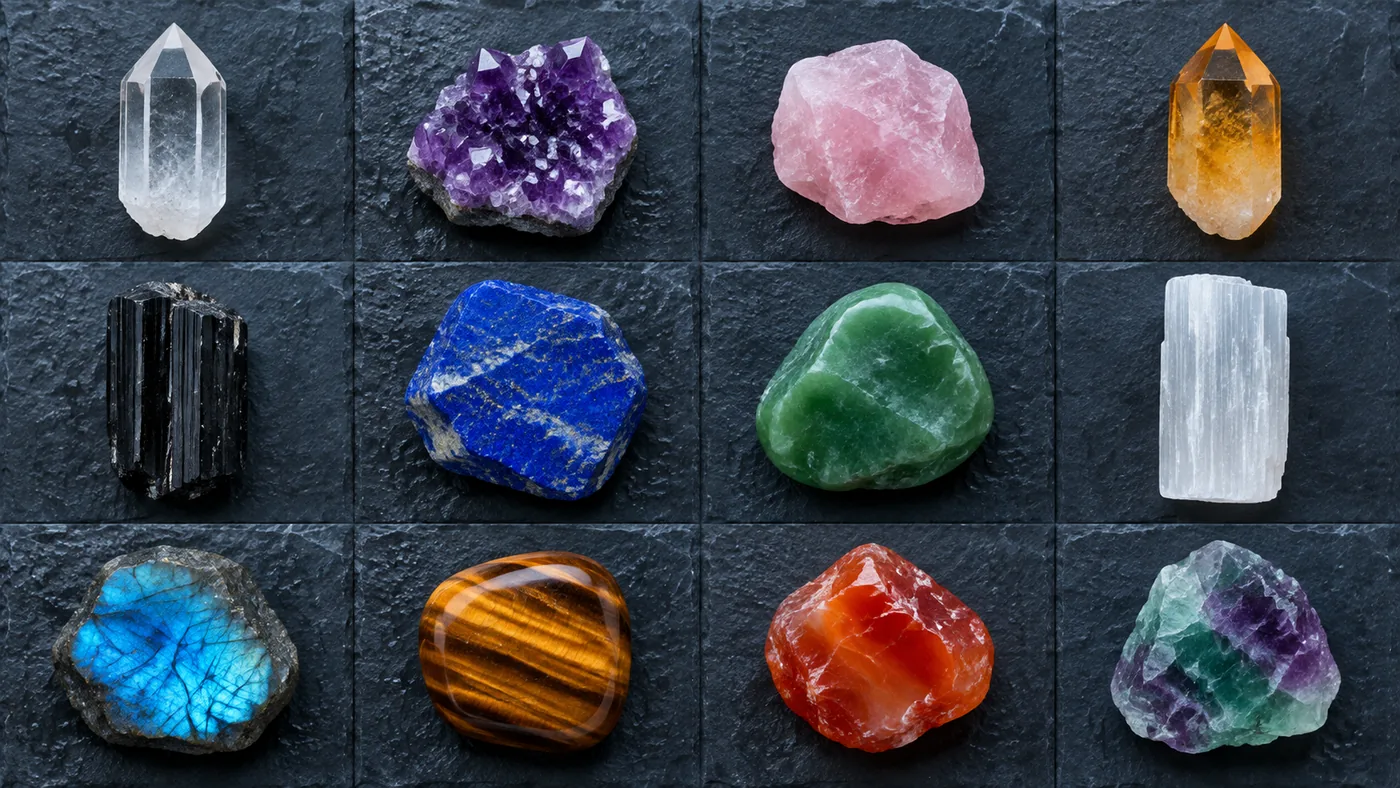
Here, “properties” means cultural or contemporary associations, not medical effects. Alongside the symbolism, you will find what each stone actually is and the material care it requires.
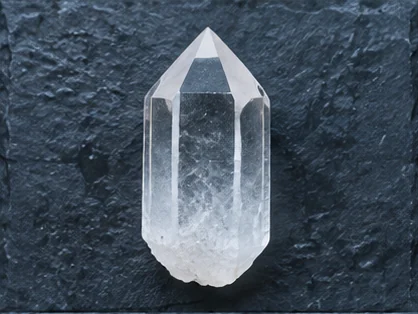 01
Traces through history. Quartz has been worked into ornaments and tools in many cultures; the piezoelectricity demonstrated by the Curies concerns specific physical phenomena, not healing.
Material care. Use a soft cloth or lukewarm water with mild soap; avoid impacts and sudden temperature changes.
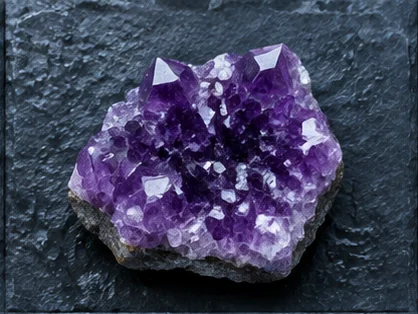 02
Traces through history. Its Greek name evokes protection against intoxication; it has been a prized gem in jewellery and ritual objects for centuries.
Material care. Use lukewarm water and mild soap if untreated; avoid heat and prolonged exposure to intense light, which can fade the colour.
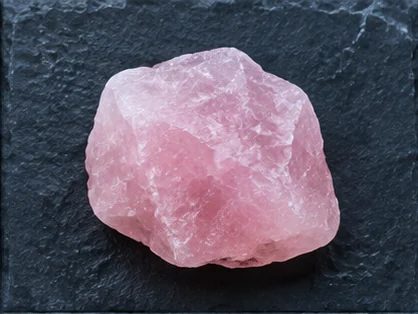 03
Traces through history. Its popularity as a stone of love belongs chiefly to modern symbolism; as a material, it is used in carvings, cabochons and ornaments.
Material care. Use lukewarm water and mild soap; avoid ultrasonic and steam cleaners, especially if you do not know whether it has been treated or has fractures.
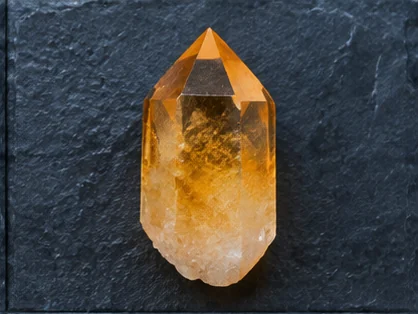 04
Traces through history. Its name evokes the lemon. Its sunny colour has encouraged associations with vitality and wealth, but it does not bring financial luck.
Material care. Avoid heat and prolonged sunlight; clean gently and always ask whether the colour is natural or produced by treatment.
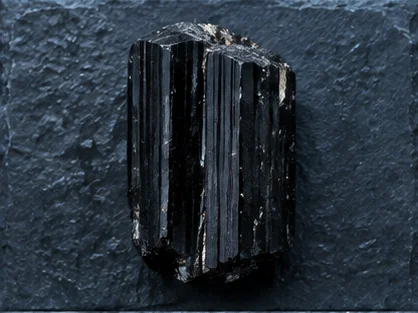 05
Traces through history. Tourmalines are known for their range of colours and electrical properties; these physical characteristics do not amount to a barrier against emotions or household radiation.
Material care. Avoid blows along the striations and sudden temperature changes; use a soft cloth and mild cleaning agents.
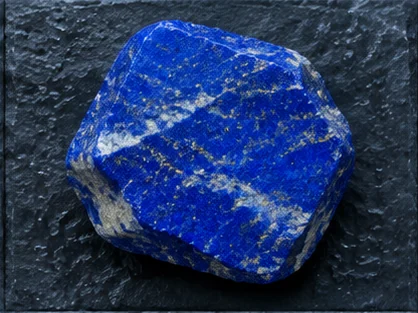 06
Traces through history. Prized in ancient Egypt and along ancient trade routes, it also became the pigment ultramarine: a history of material, art and labour before any story of energy.
Material care. A porous and relatively soft material: avoid immersion, acids, ultrasound and harsh products; use a dry or barely damp cloth.
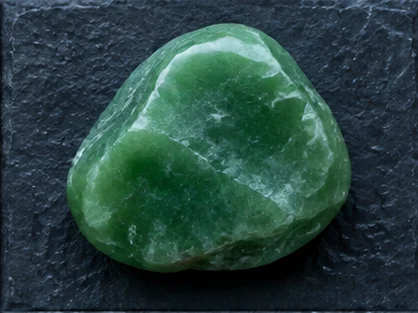 07
Traces through history. Neolithic objects, Chinese rituals, Olmec and Maya masterpieces and Māori ornaments tell distinct stories: there is no single “meaning of jade”.
Material care. Toughness does not remove the risk of chipping or the presence of treatments; avoid heat, acids and bleach, and clean gently.
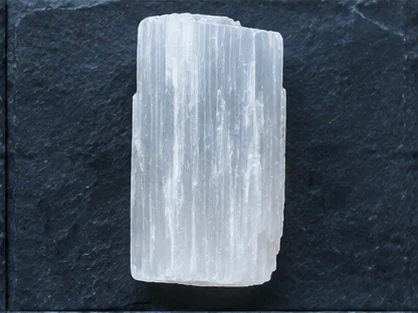 08
Traces through history. Its name evokes Selene, the Moon; its widespread use as a tool for “cleansing” other stones is a practice of contemporary spirituality.
Material care. It scratches easily and is sensitive to water: no immersion, salt or aggressive cleaning; use only a soft, dry cloth.
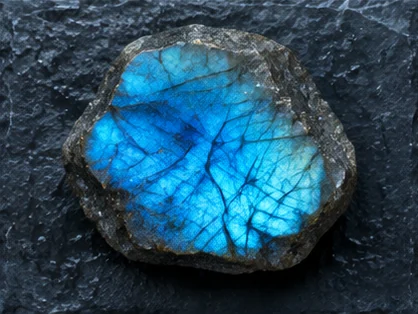 09
Traces through history. It takes its name from the region of Labrador; its spiritual meaning is recent, while the optical phenomenon arises from the mineral’s internal structure.
Material care. It has cleavage planes: avoid impacts, pressure and ultrasound; clean with a soft cloth and very little water when needed.
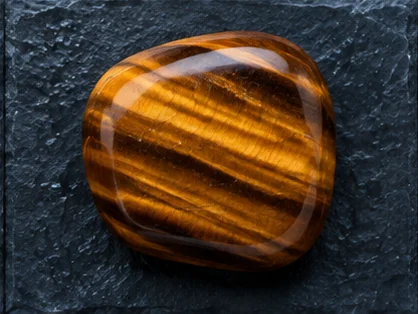 10
Traces through history. Its resemblance to an eye has inspired associations with vigilance; today it is valued above all for the movement of light across its polished surface.
Material care. An intact, polished specimen can be maintained with gentle cleaning; do not cut or grind unknown materials, as the dust can be hazardous.
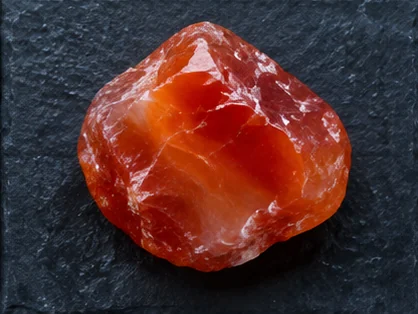 11
Traces through history. Carved and set since antiquity, it appears in seals and amulets; its colour may be natural or enhanced by heat and dye.
Material care. Use lukewarm water and mild soap if there are no sensitive treatments; avoid intense heat and chemicals.
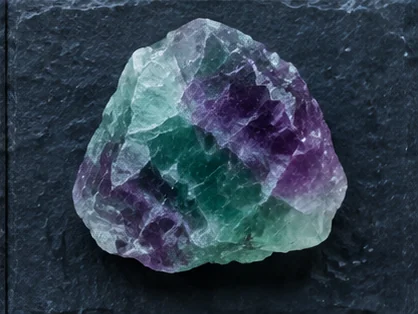 12
Traces through history. The mineral from which fluorescence takes its name; the beauty of its colour bands goes hand in hand with considerable fragility.
Material care. It scratches and cleaves easily: avoid impacts, acids, ultrasound and heat; store separately and clean with extreme care.
THE CRYSTAL ENCYCLOPEDIA
Twenty-four full entries distinguishing matter, tradition and ornamental use. Correspondences with chakras and emotions are spiritual conventions, not clinical effects.
Material. The colourless, transparent variety of quartz (SiO₂), with a Mohs hardness of 7 and a trigonal crystal system. Light can reveal inclusions, growth planes, healed fractures and internal reflections. Polished surfaces and spheres allow different observations from natural points. Contemporary tradition. Clarity, concentration, harmony and, in esoteric language, symbolic “amplification”. Objects: points, spheres, clusters, wands, pendulums, pendants.
Material. The purple variety of quartz; its colour is linked to colour centres and iron within the structure. Mohs hardness 7. It occurs as individual crystals, geodes and clusters, in shades ranging from lavender to deep purple. Some specimens can change colour following heat treatment, and prolonged exposure to unfavourable lighting conditions can alter their colour. Tradition. Contemplation, calm, intuition; frequently associated with the crown chakra or third eye.
Material. The pink variety of quartz, often occurring in translucent masses with delicate clouding. The causes of its colour can vary according to the material. It lends itself to spheres, pendants, small carvings and polished points. Tradition. Love, affection, relationships, emotional sensitivity. Frequently associated with the heart chakra. Distinction: there is no evidence that it acts on the cardiovascular system or mood through an energy emission of its own.
Material. The yellow or yellow-orange variety of quartz. It is important to distinguish natural citrine from heated amethyst, which is very common on the market, when information is available. Tradition. Optimism, vitality, initiative, abundance; contemporary association with the solar plexus. Ornamental use: jewellery and spheres, as well as clusters and crystals.
Material. Quartz in shades from grey to brown, sometimes very dark; the colour is connected with colour centres in the crystal structure. Tradition. Grounding, stability, symbolic protection. Objects: points, spheres, jewellery and sculptures. A photograph taken in strong light can make it appear lighter or darker: identification should not be based on a single image.
Material. The black variety sold commercially is frequently schorl, which belongs to the complex tourmaline group. It often forms striated prismatic crystals. Tradition. Protection and stability. Scientific caution: the use of black tourmaline as a “shield against radiation or electromagnetic waves” is not supported by scientific evidence for a piece of jewellery or a crystal left in a room.
Material. Pink or reddish tourmaline, often elbaite in gem materials; it can display widely varying shades and colour zoning. Not all red or pink stones are tourmalines, and not all pink tourmalines have the same gemmological value. Tradition. Affection, sensitivity and compassion. Objects: cabochons, faceted gemstones, crystal fragments for ornamental compositions, jewellery.
Material. Chalcedony, a microcrystalline form of silica, with colours ranging from orange to reddish brown, largely due to iron compounds. Historically used for engravings, seals, necklaces and amulets. Modern tradition. Creativity, courage and initiative; association with the sacral chakra. Historical value: its use in Egypt and the ancient Near East is particularly interesting.
Material. A rock, not a single mineral: its blue colour is chiefly associated with lazurite. It may contain white calcite and golden pyrite. Historically a precious material for jewellery and pigments. Modern tradition. Wisdom, vision, communication. Caution: do not confuse it with dyed sodalite or other imitations.
Material. A basic copper carbonate, recognisable by its green colour and the concentric bands visible in polished sections; relatively low hardness. Modern tradition. Transformation, change, heart symbolism. Safety: avoid dust, drinking preparations, acidic substances and improper uses; handle intact carvings and objects under normal conditions.
Material. A plagioclase feldspar known for its potential labradorescence, iridescent effects produced by the interaction of light with internal structures. Tradition. Imagination, introspection, symbolic protection. Useful information: blue, green or golden reflections change according to the stone's orientation, not the owner's emotional state.
Material. A gemmological term referring to feldspars that may display adularescence. The light effect arises from the material's internal structure. Some varieties sold as “rainbow moonstone” belong to the plagioclase feldspar family. Tradition. Cycles, intuition, change. Objects: cabochons, rings and pendants.
Material. Aventurescent quartz, often green because of inclusions of minerals such as fuchsite; its colour and sparkle depend on inclusions and microstructures. Tradition. Balance, openness and serenity, often associated with the heart chakra. Commercial note: not every “green jade” is jade; aventurine and jade are different materials.
Material. A quartz material with the characteristic optical effect of chatoyancy, linked to its fibrous structure and cut. The colour can be golden, brown or, in other related materials, blue. Tradition. Determination, protection, concentration. Modern association: solar plexus.
Material. A group of minerals with different compositions and colours; not all garnets are red. Some specimens form very regular dodecahedral crystals. Tradition. Constancy, passion, grounding. Modern association: root chakra. In commercial descriptions, state the species (almandine, pyrope, etc.) only if verified.
Material. The light blue or blue-green variety of beryl, with a Mohs hardness of 7.5–8. Its colour is linked to iron. Tradition. Clarity of expression and serenity, often symbolically connected with the throat chakra. Use: faceted stones, cabochons, collectible crystals.
Material. The term chiefly denotes two distinct materials, nephrite and jadeite, each with its own properties and geological history. Its cultural history is extensive, from Chinese Neolithic ritual jades to pounamu in Māori tradition. Contemporary tradition. Harmony, balance, prosperity. Do not automatically transfer specific Indigenous meanings into universal New Age formulas.
Material. Gypsum (CaSO₄·2H₂O) has a Mohs hardness of 2; “selenite” is commonly used for transparent varieties and commercially sold fibrous materials. It marks easily and is sensitive to water. Tradition. Symbolic purification and stillness. Care: do not immerse in water or rub with abrasive materials.
Material. Natural volcanic glass, not a crystalline mineral in the strict sense; it can display bands, inclusions and distinctive reflections. Some cuts have sharp edges. Tradition. Protection, introspection, engagement with the shadow. Safety: handle unpolished specimens with care.
Material. Iron oxide (Fe₂O₃), with a metallic lustre in crystals or on polished surfaces. Tradition. Grounding and stability. Caution: many strongly magnetic metallic products sold as “magnetic hematite” are not natural hematite.
Material. Calcium fluoride (CaF₂), with a Mohs hardness of 4, occurring in many different colours and sometimes fluorescent under UV light. Tradition. Mental order and concentration. Care: fragile compared with quartz, sensitive to impacts and, in some varieties, light; do not use in drinking preparations.
Material. Iron disulphide (FeS₂), known for its brass-coloured metallic lustre and often cubic crystals. It can oxidise under unfavourable environmental conditions. Tradition. Willpower, wealth, symbolic protection. Care: avoid prolonged exposure to moisture for specimens susceptible to deterioration.
Material. Hydrated silica, often lacking the crystalline order of common minerals; some varieties display a play of colour caused by the diffraction of light. Tradition. Imagination, sensitivity, creativity. Care: depends on the type and treatments; avoid thermal shock and follow specific guidance.
Material. A manganese silicate, often pink or red with black veins of manganese oxides. Tradition. Emotional balance, compassion, reconciliation. Objects: carvings, spheres, pendants and polished slabs.
The correspondence between stones, chakras and emotions is a contemporary spiritual convention that can vary between traditions. The mineralogical profiles describe material characteristics, not clinical effects. When buying a gemstone, it is also useful to assess authenticity, treatments, quality of workmanship and material care.
The wand appears in various narrative and ritual traditions, but the Crystal Healing Wand objects sold today belong chiefly to the language of contemporary crystal healing. They are made as simple objects carved from a polished crystal, or as complex compositions combining minerals, glass tubes, metal parts, spheres and points. They do not all share the same history, and it is not accurate to attribute an undocumented ancient origin to each one.
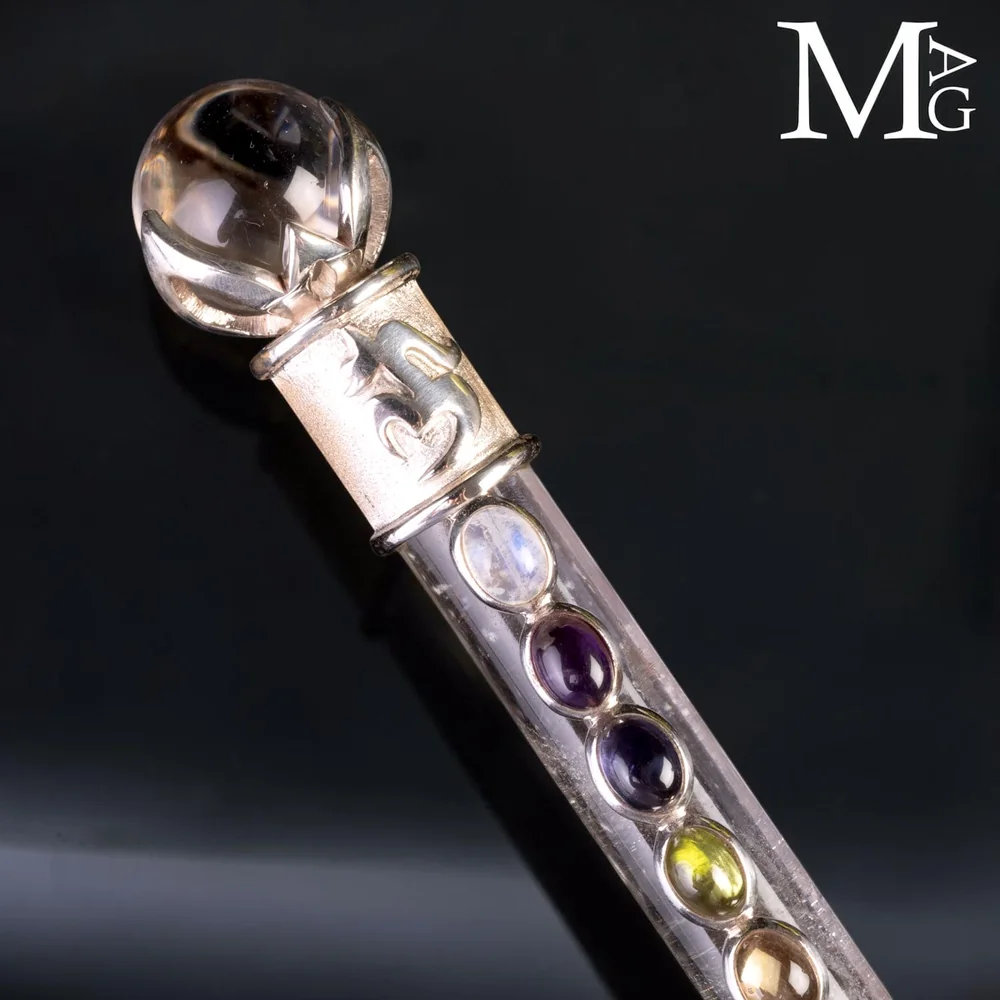
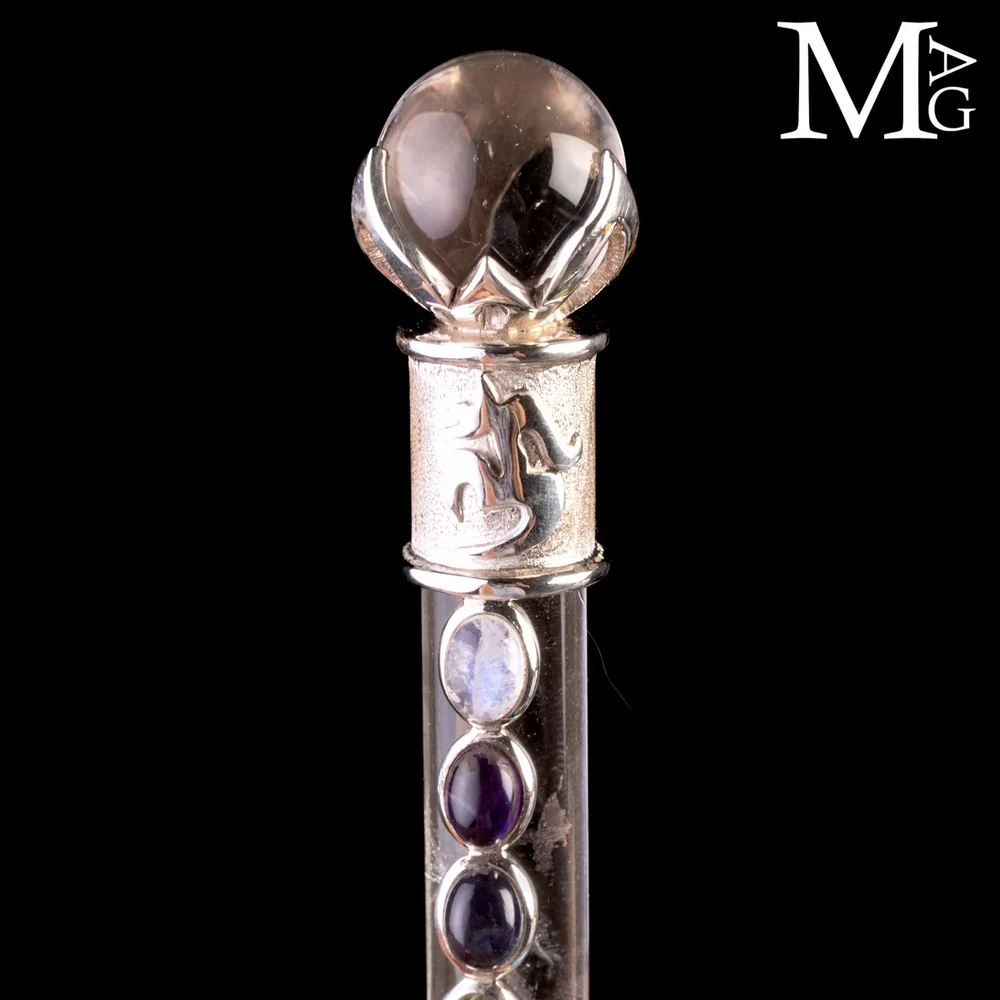
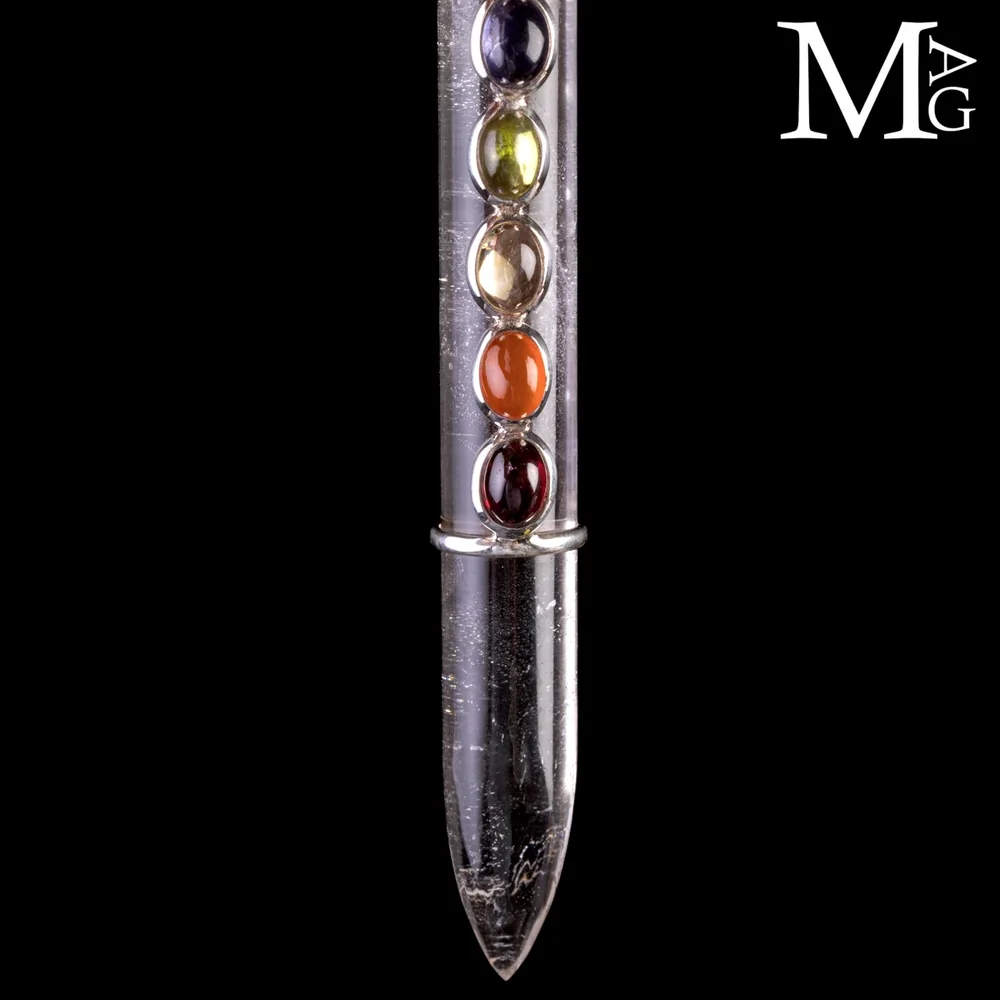
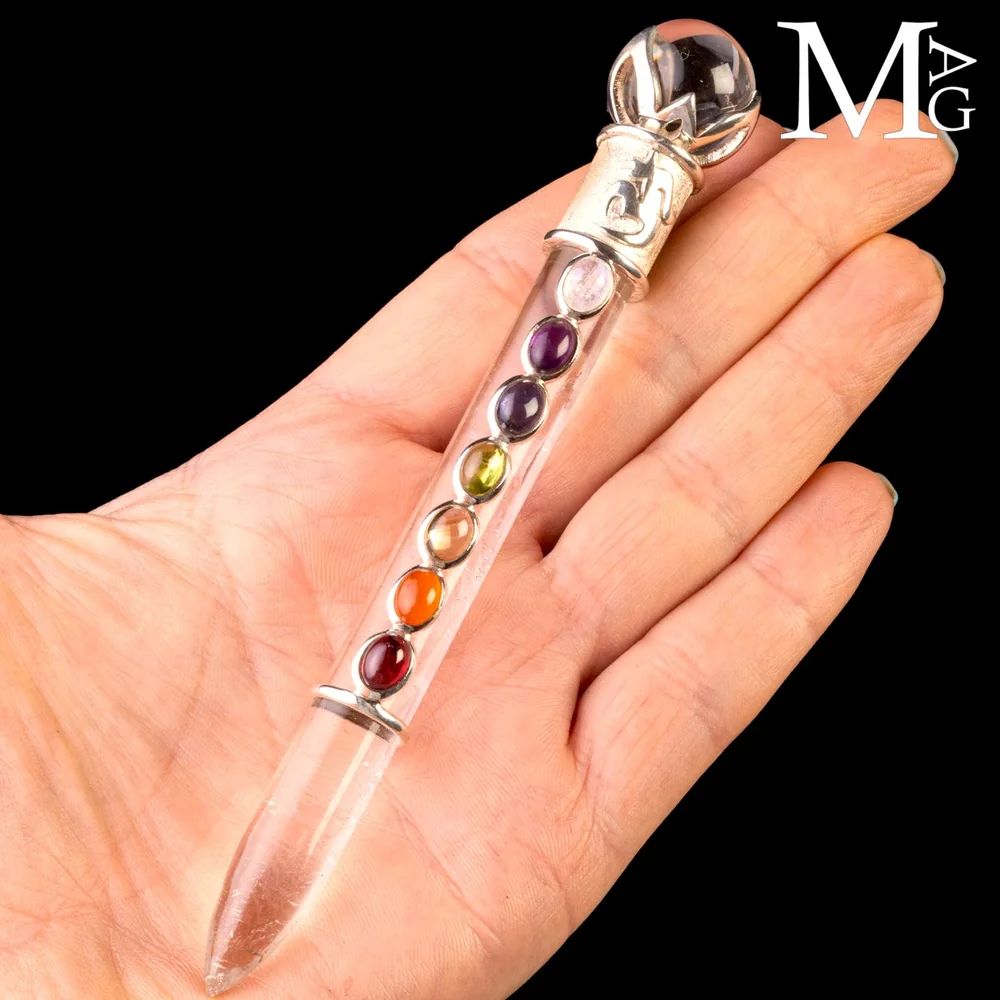
The elongated shape is particularly recognisable: it is held around the middle and has one or two worked ends. Some models have double-terminated points, others consist of a crystal shaped as a massage tool, while others have a sphere at the top and a point below. More elaborate versions may contain gemstone fragments in a transparent cylinder or a sequence of coloured stones symbolically dedicated to the chakras.
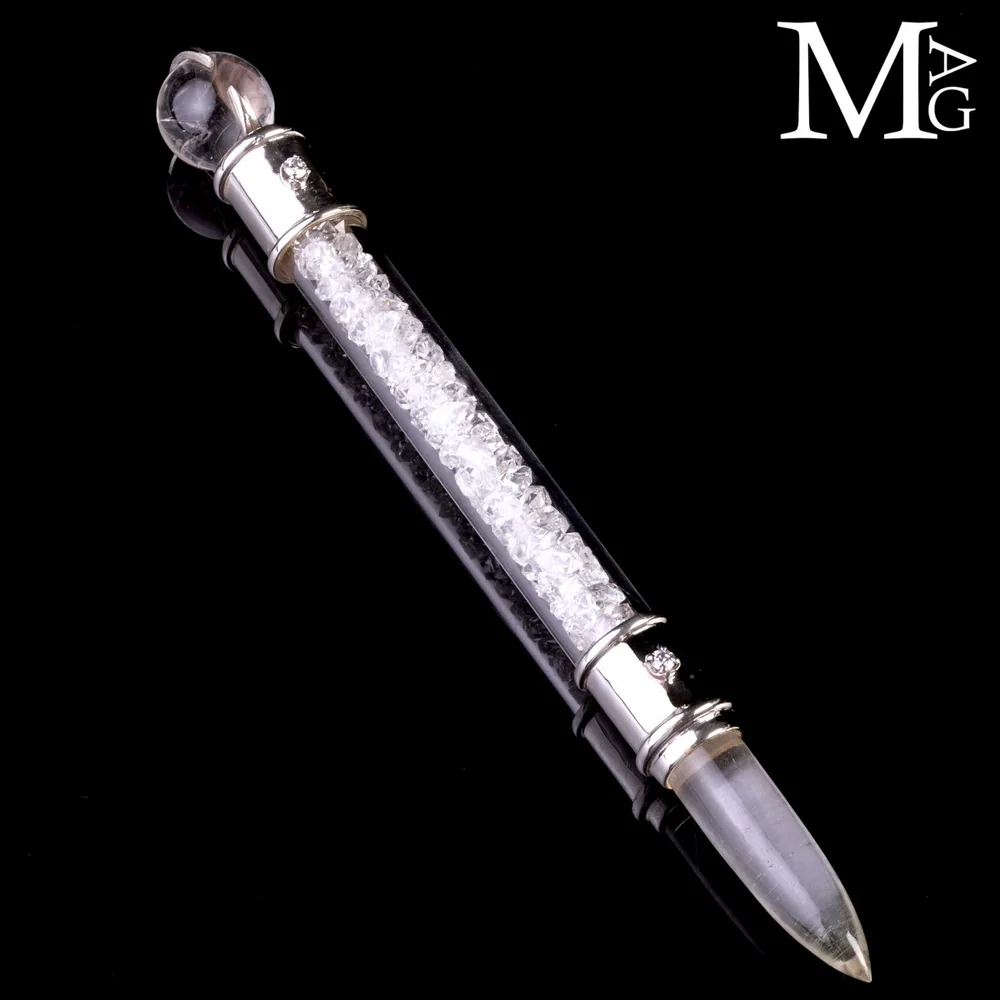
A rock crystal sphere is a form of craftsmanship that highlights the stone's clarity, reflections, refraction and internal characteristics. Its curved surface has no preferred orientation and changes appearance as it is rotated. An elongated point, by contrast, emphasises the object's geometric and directional qualities. Between them, a cylinder filled with small crystals produces a different visual effect: light encounters numerous angled surfaces and is reflected in many directions.
These are three ways of presenting the same mineral, or several minerals together. The aesthetic difference does not require a supernatural explanation: it arises from the nature of the stone and the skill of the craftsperson who works it.
In contemporary crystal-healing practices, some people gently hold the wand during meditation, orient it within a space or bring it close to an area of the body without applying pressure. The sphere is often interpreted as a symbol of diffusion; the point as a symbol of concentration or direction. However, the schools do not share a universal method, and these attributions do not describe proven physical phenomena. If a wand is used near the skin, movement must be gentle and non-invasive; avoid contact with eyes, mucous membranes, wounds or sensitive areas.
Rock crystal and rose quartz. A clear sphere at the top, a cylinder containing tiny quartz crystals and a rose quartz point: a combination of transparency and delicate shades. Modern esoteric interpretations attribute a symbolism of affection to rose quartz, while rock crystal is associated with clarity.
Pink tourmaline and rose quartz. The cylinder holds fragments of pink tourmaline in varying shades; above it is a rock crystal sphere, below it a rose quartz point. The main interest lies in observing the colour variations in the small crystals, ranging from pale pink to red and sometimes greenish shades. For specimen JLH38, a total length of 160 mm and an upper sphere of 16 mm are confirmed.
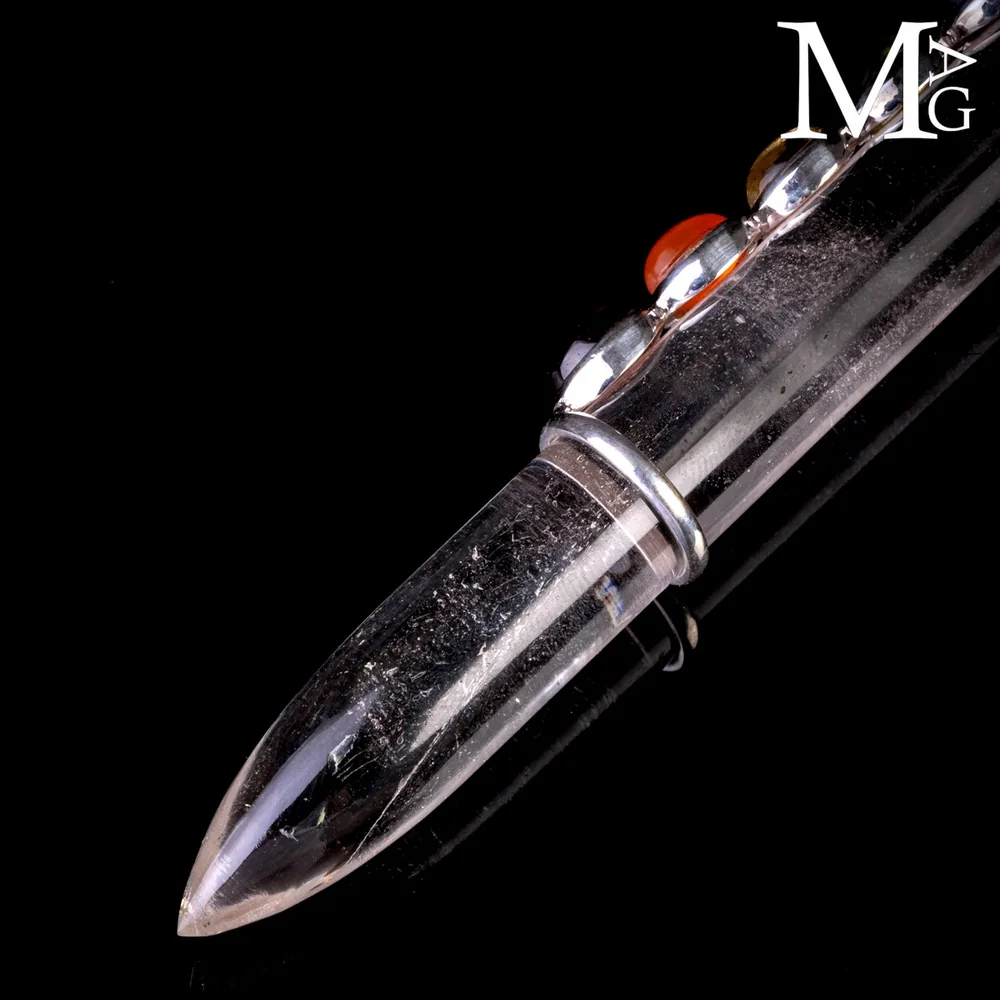
Quartz with seven chakra gemstones. A clear quartz wand with seven oval cabochons set in silver, arranged in a colour progression symbolically linked to the seven chakras. It is a striking visual example of the meeting between ornamental gemmology and modern spiritual correspondences. Do not identify the individual cabochon species without confirmation.
Rock crystal in three worked forms. A sphere, tiny quartz crystals in the cylinder and a solid quartz point: the same material offers continuous, fragmented and tapered surfaces. From a photographic perspective, it is an ideal subject for observing light within crystal.
There is a specific category of crystals cut according to geometries and proportions associated with Marcel Vogel's research and ideas in the twentieth century. This should be distinguished from the generic name Crystal Healing Wand: a wand with a sphere, cylinder or decorative fittings does not automatically become a “Vogel crystal”. Avoid generalisations and unjustified attributions.
Interest in these wands extends beyond ritual. The choice of stone, quality of polish, construction, strength of the settings and proportions make them objects of ornamental jewellery and collecting. They therefore offer a fitting meeting point between the page's two worlds: symbolic storytelling and direct observation of the material.
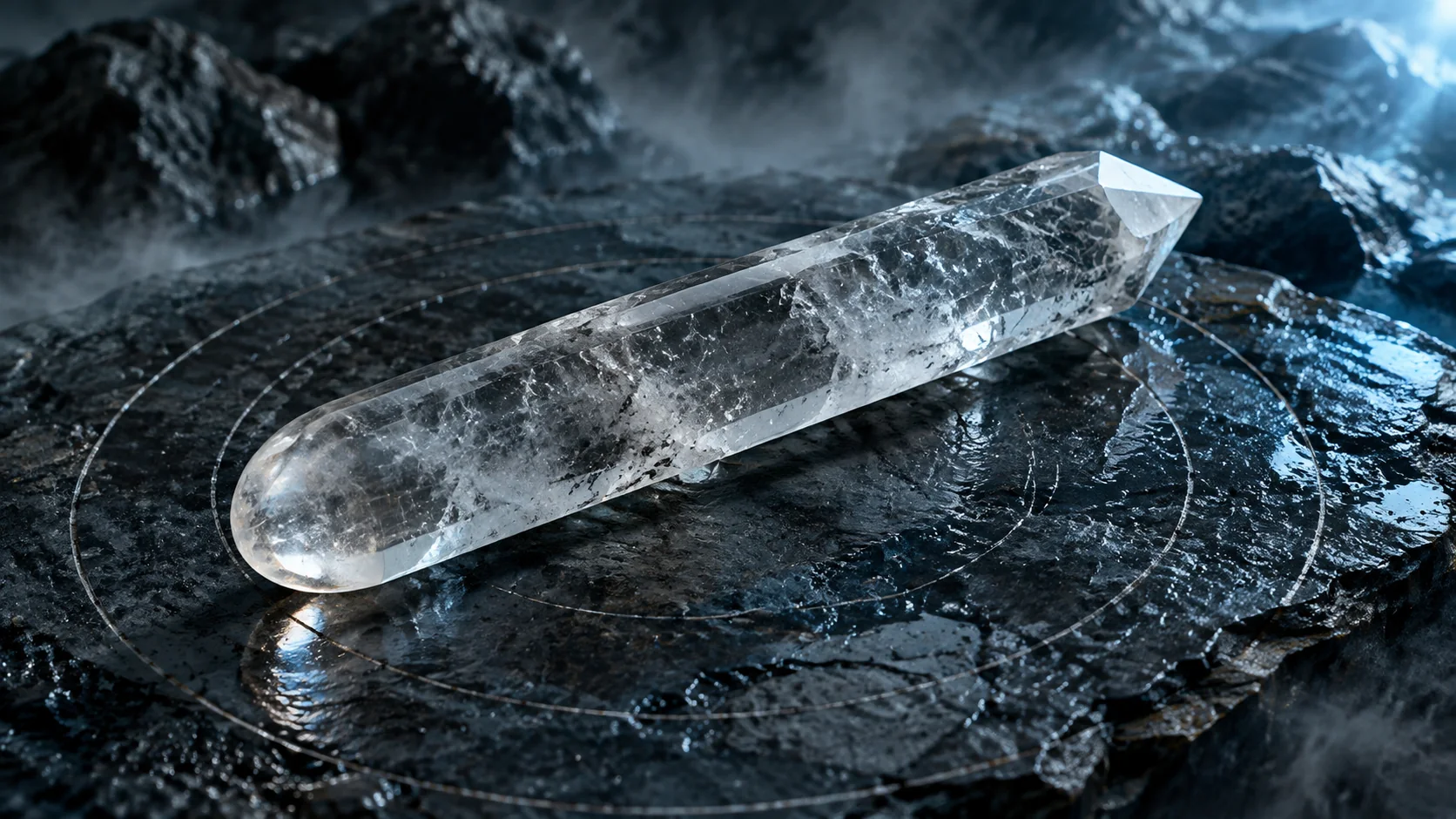
A stone shaped into an elongated form, with one or two points or a rounded end. In contemporary practices, it is used to direct energy and intention symbolically, accompany meditation or trace arrangements. As a tactile tool it can support manual massage, but points, fragility and pressure call for care: it is not a therapeutic device.
AI-generated editorial images: they illustrate the materials, rather than documenting authentic artefacts or rituals.
Original Mineral Art Gallery photographs document real forms, workmanship and details. They do not indicate prices or availability; measurements are stated only for JLH38.
JLH37
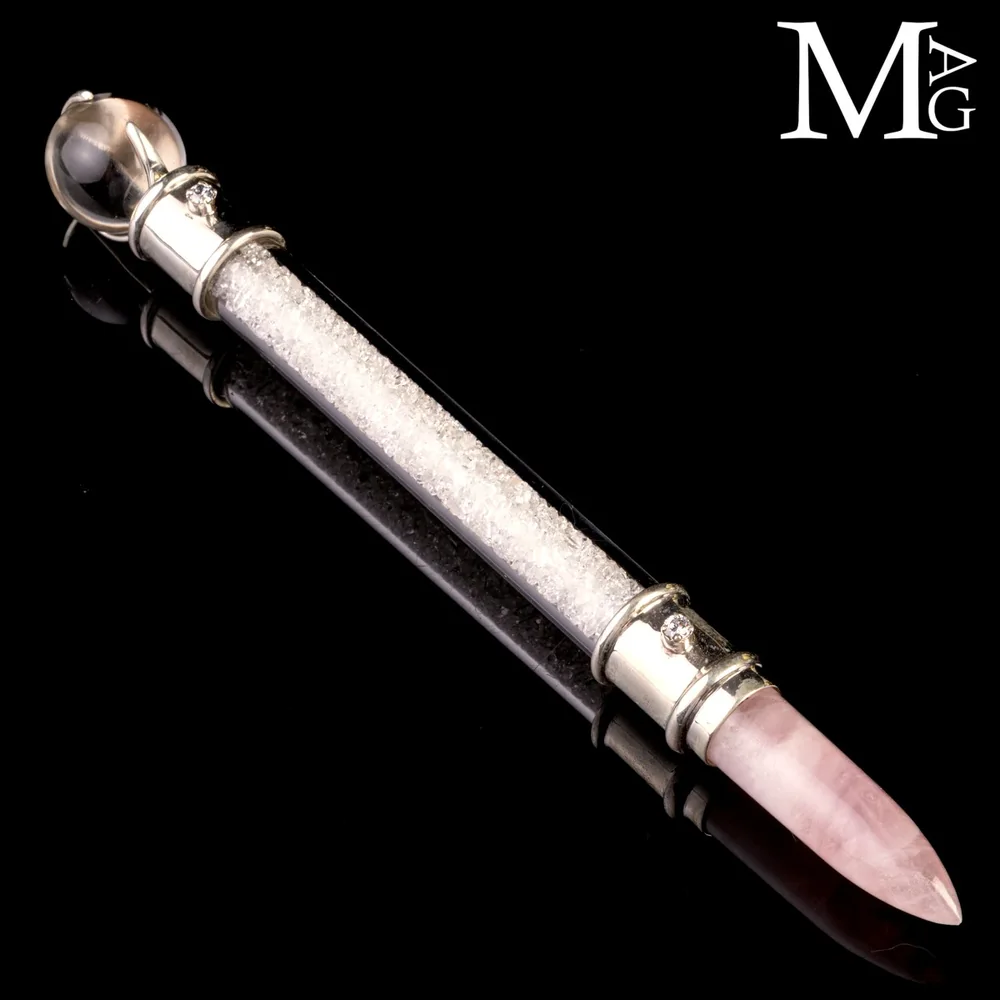
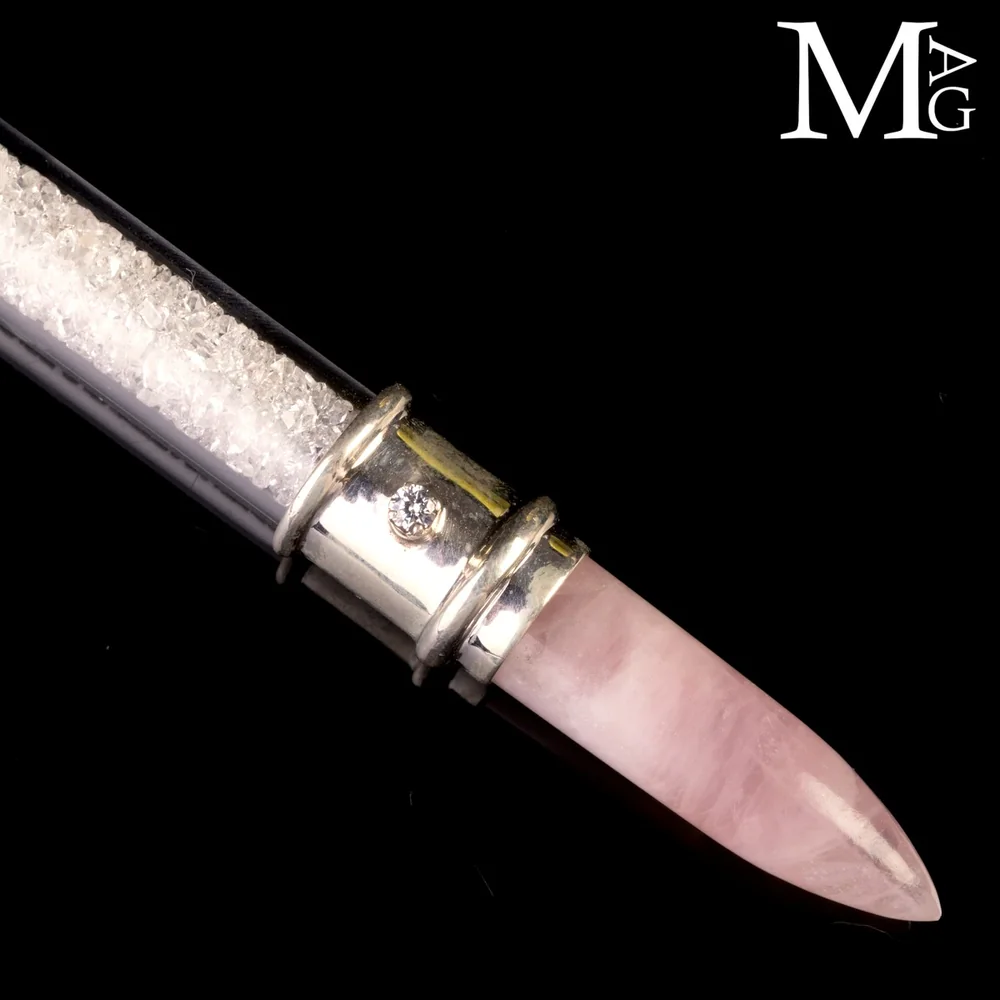
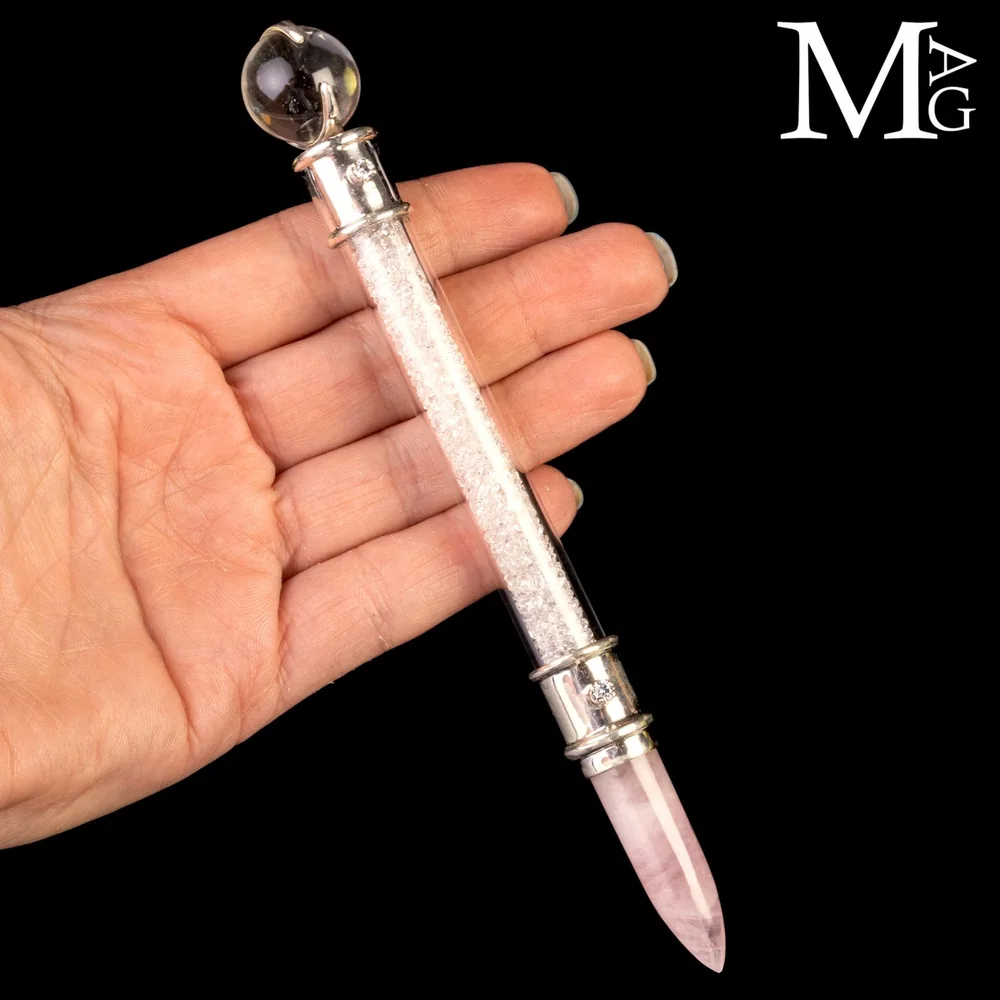
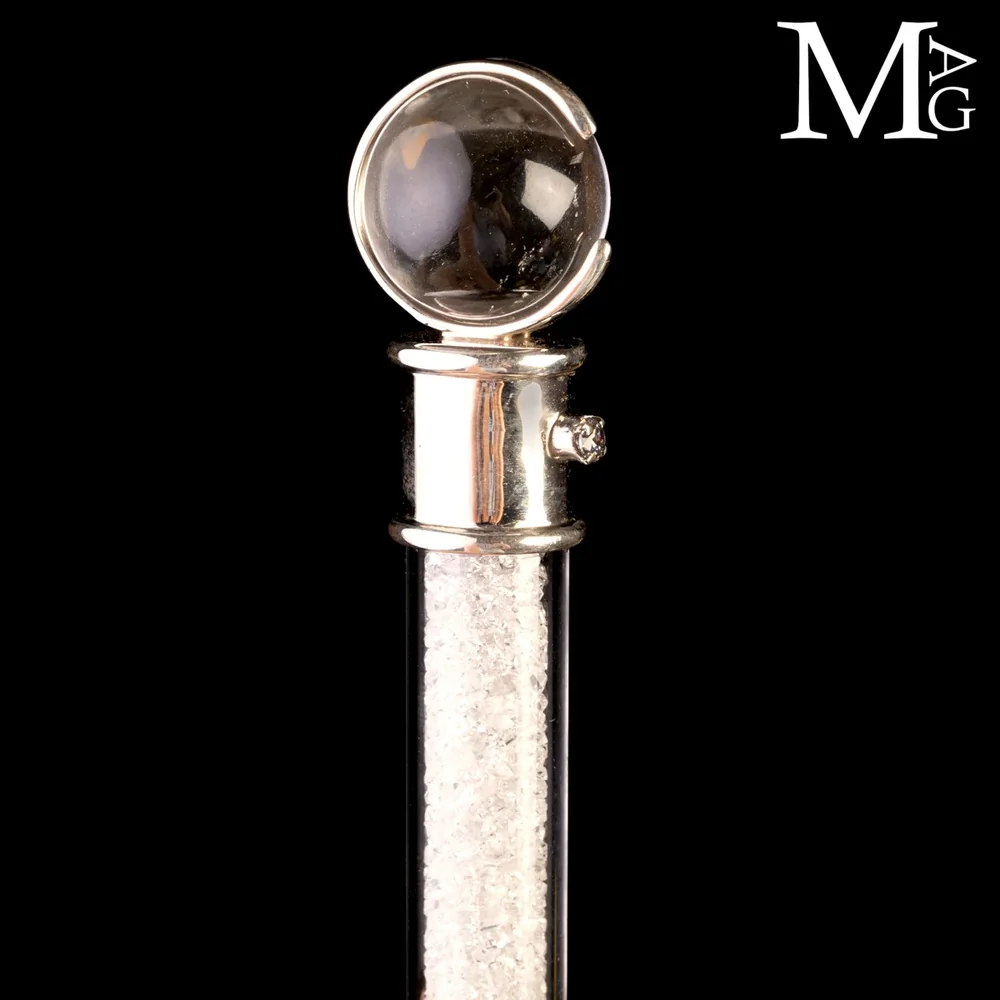
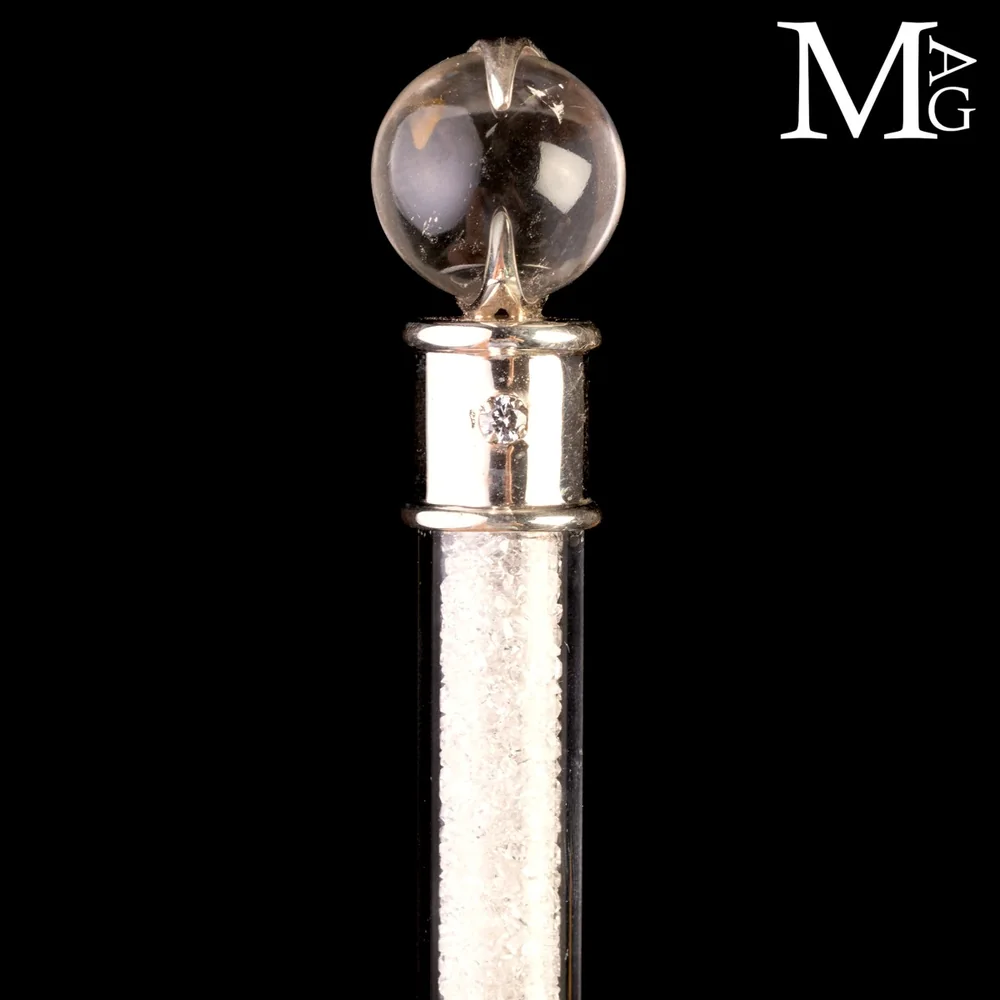
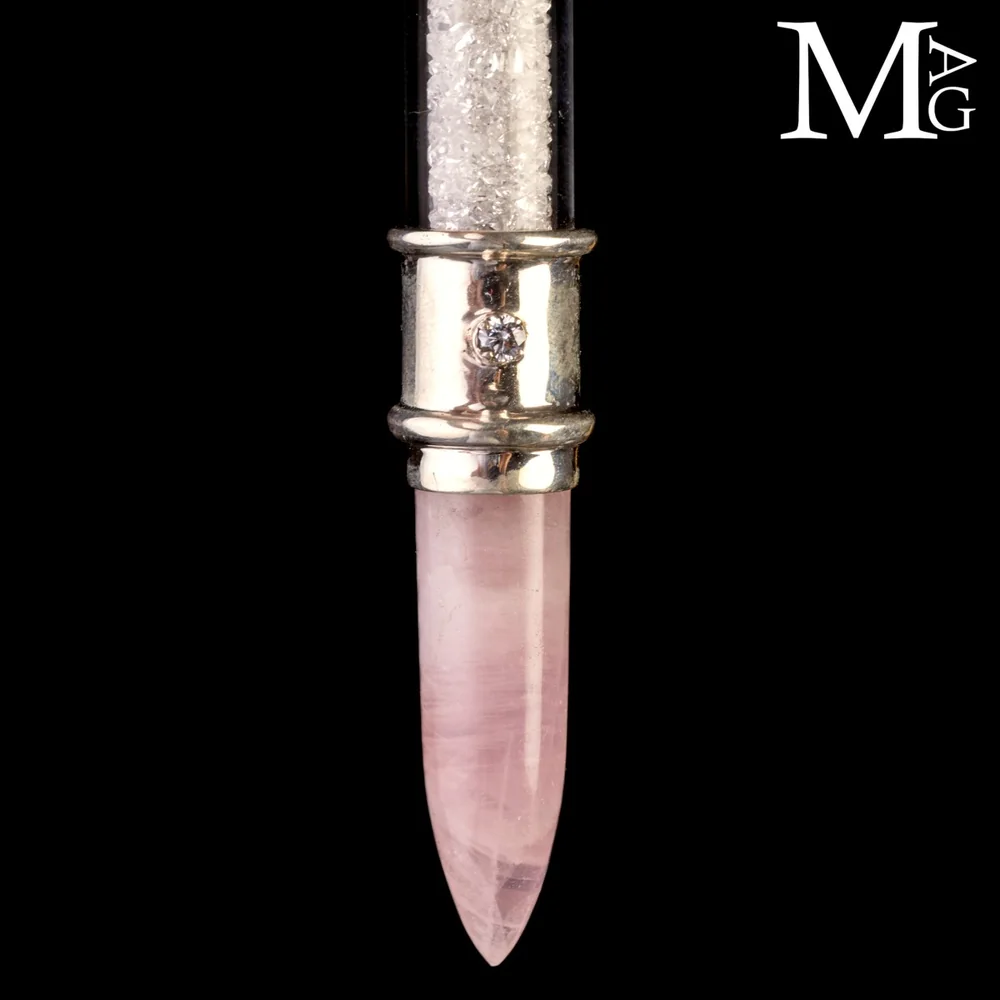
JLH38
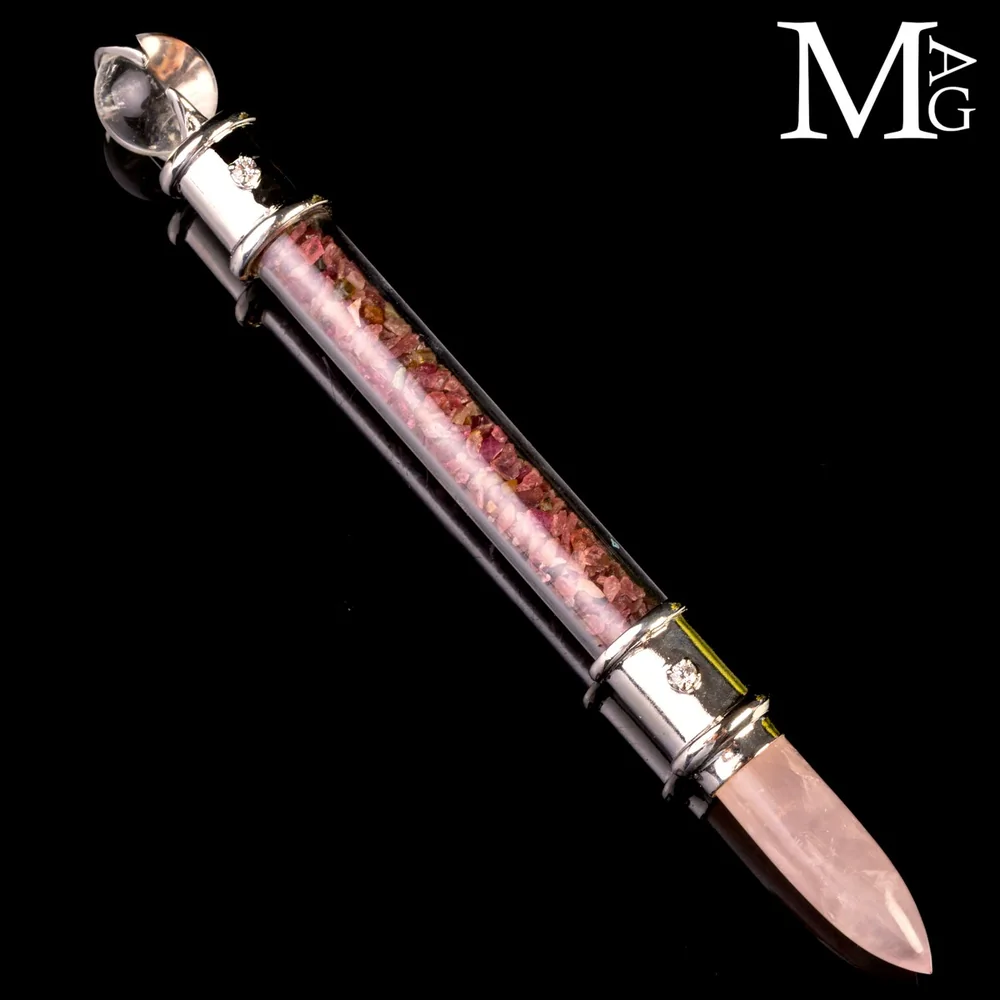
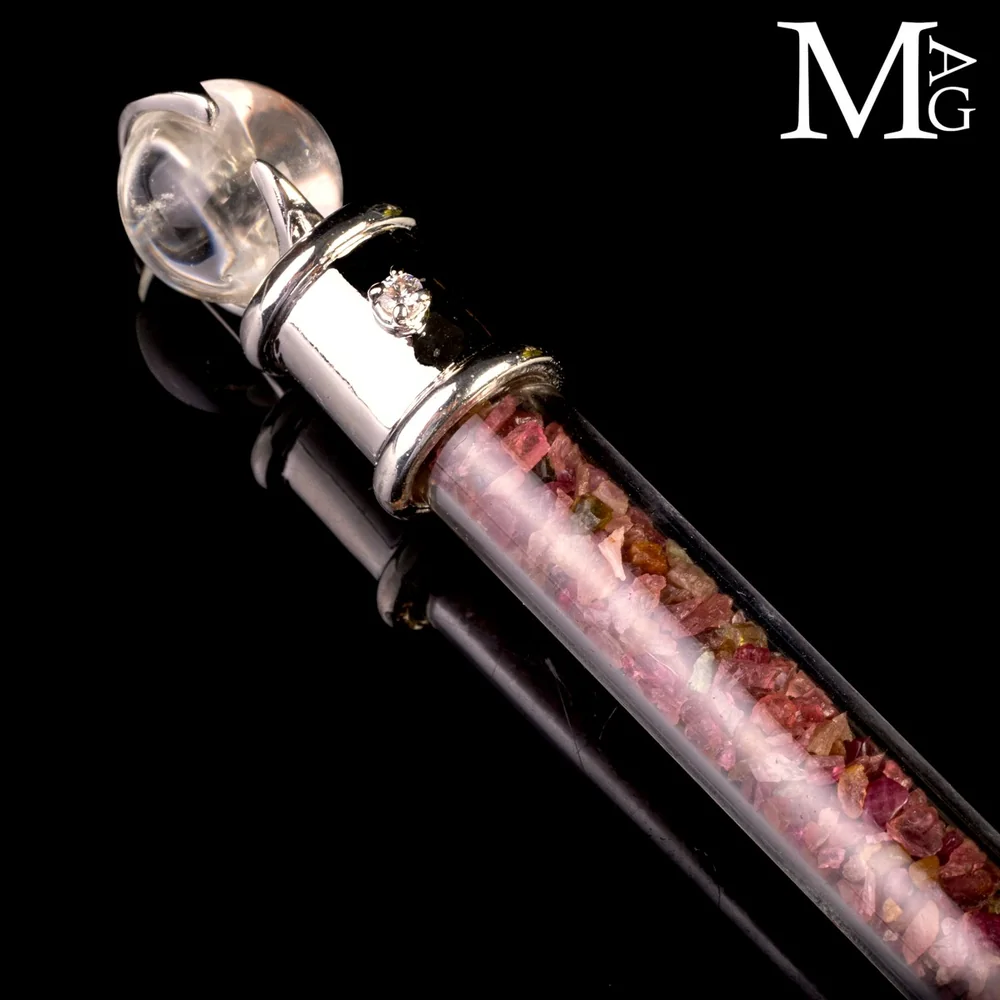
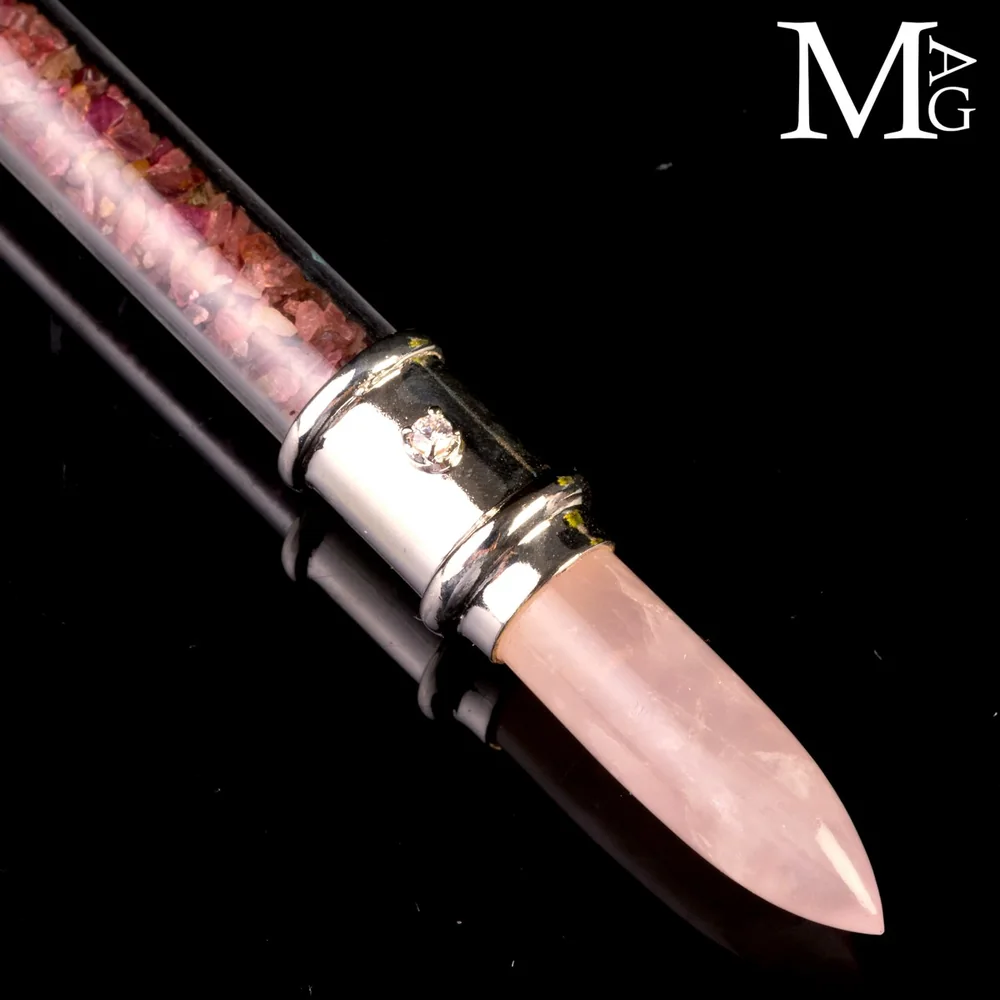
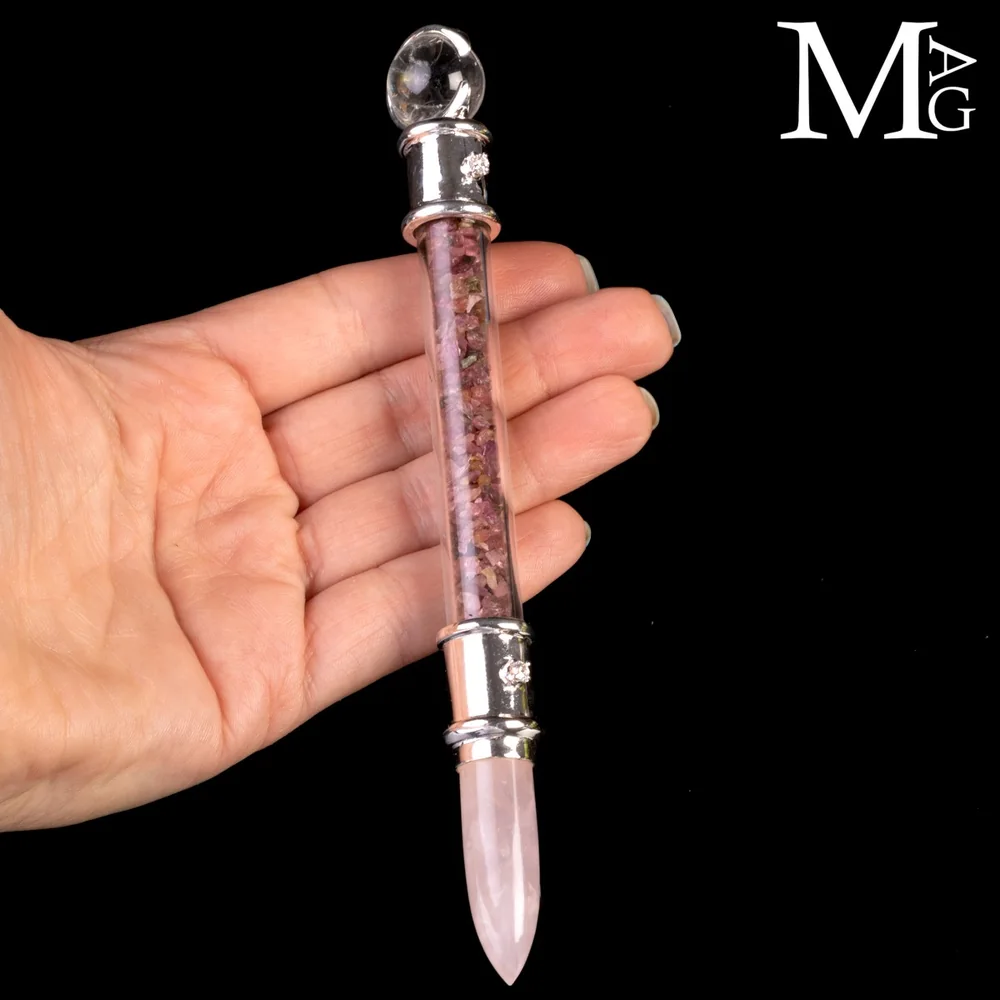
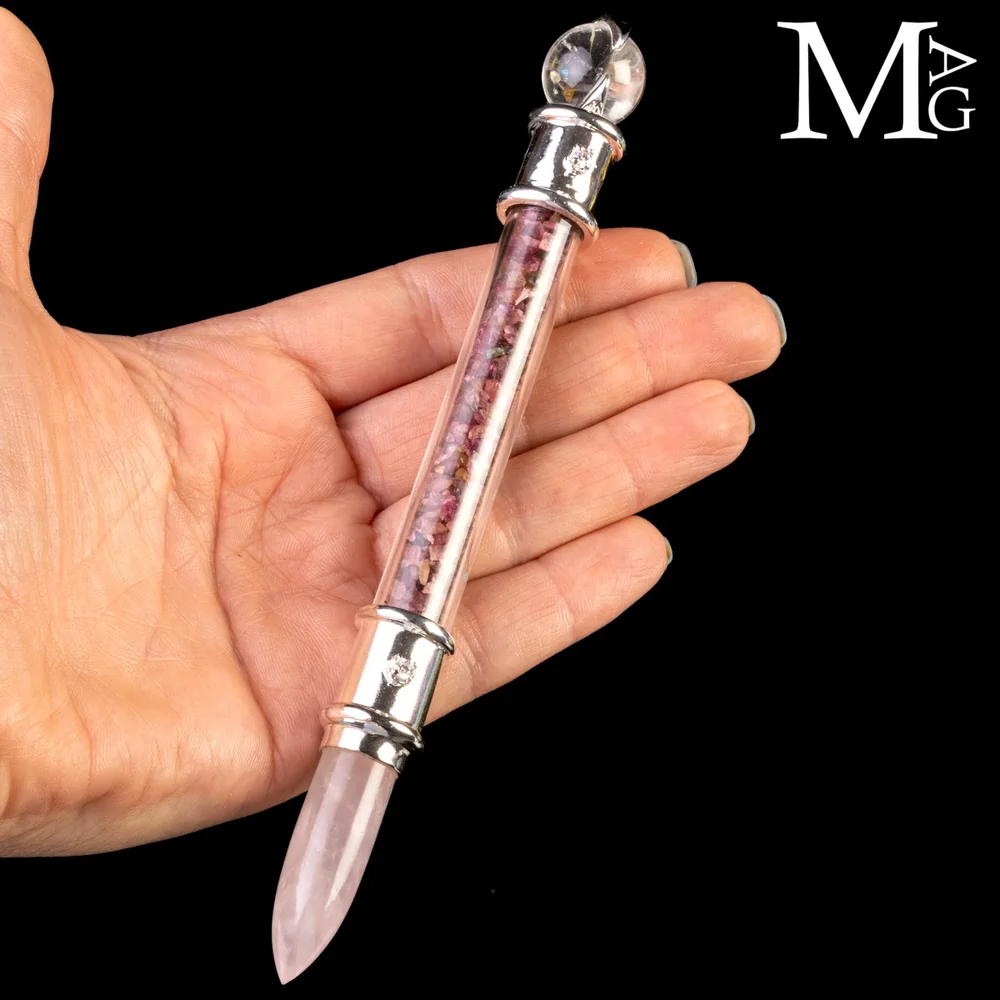
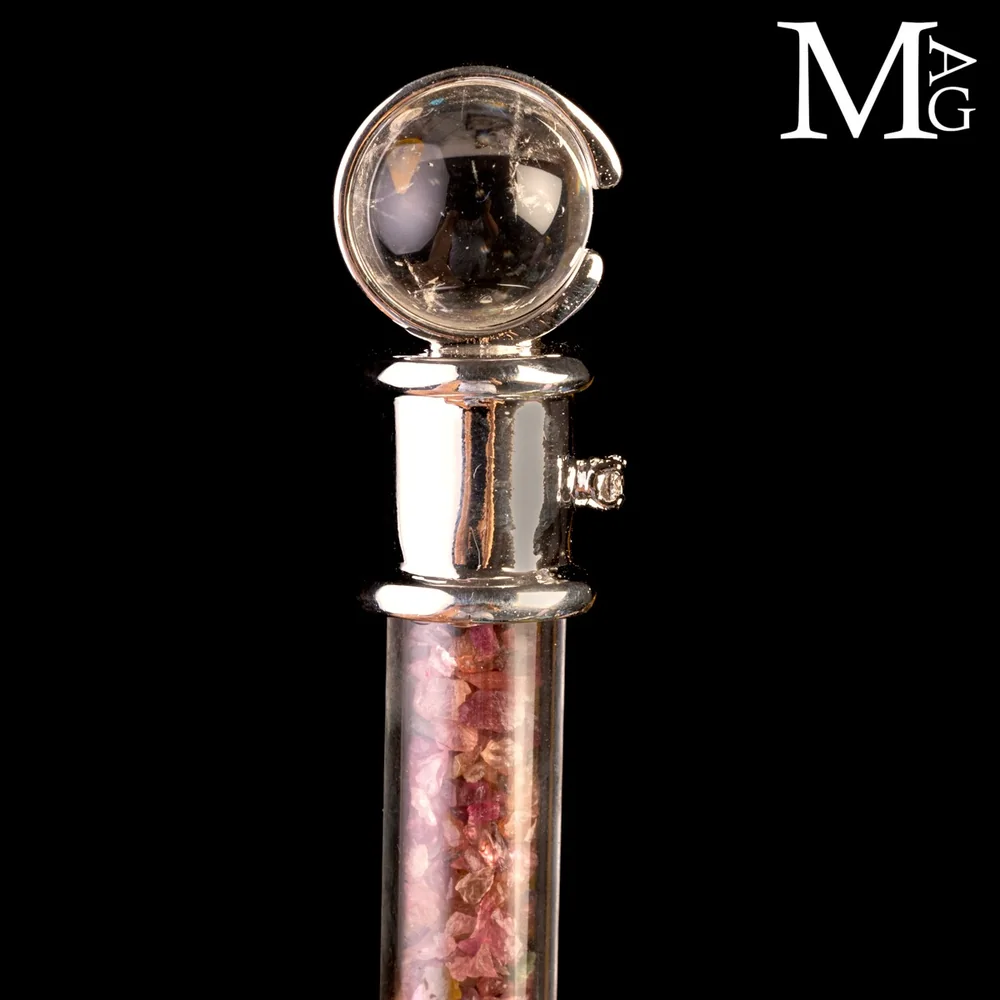
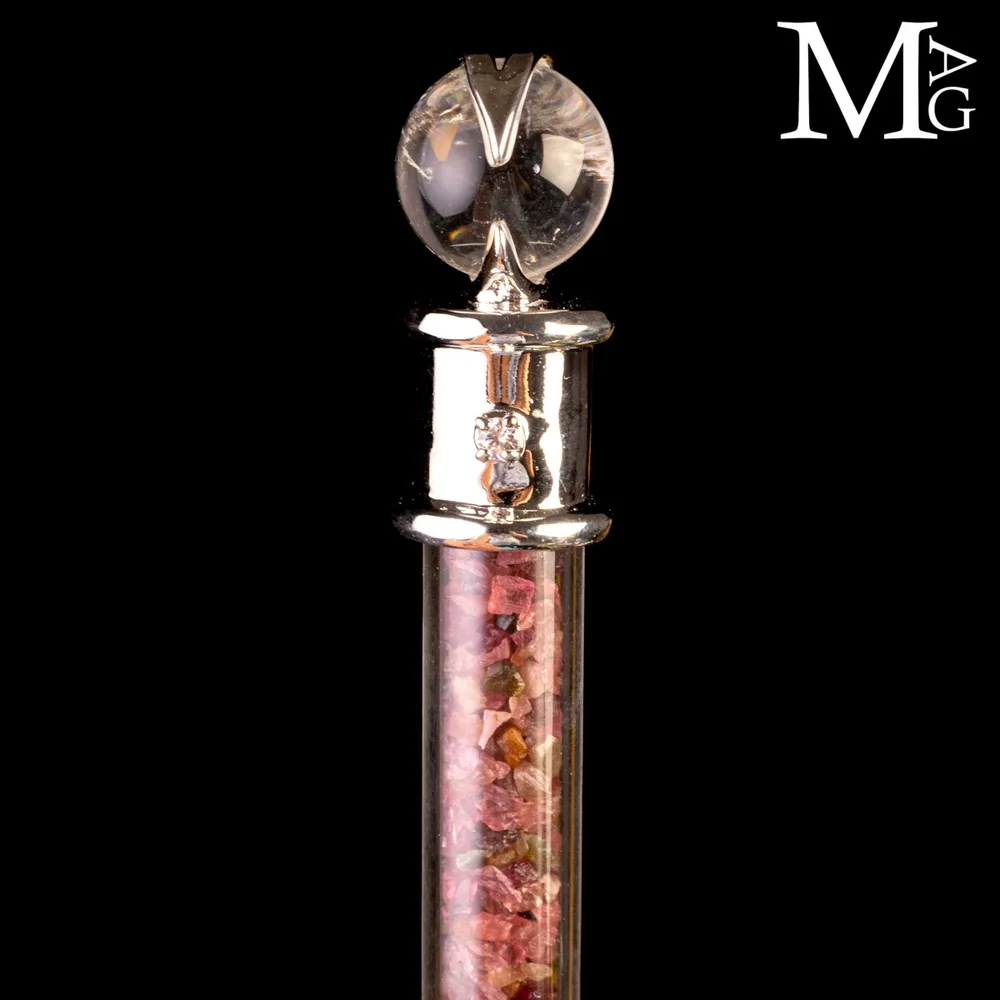
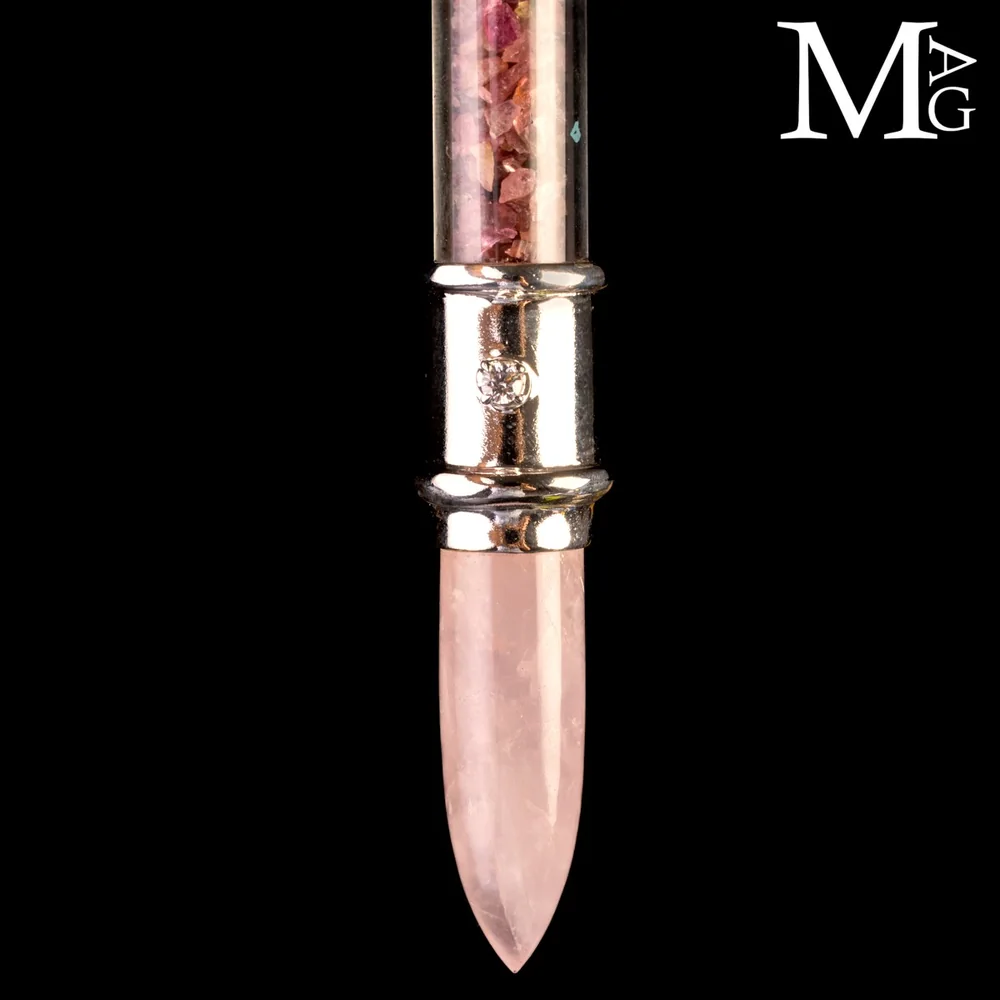
JLH39
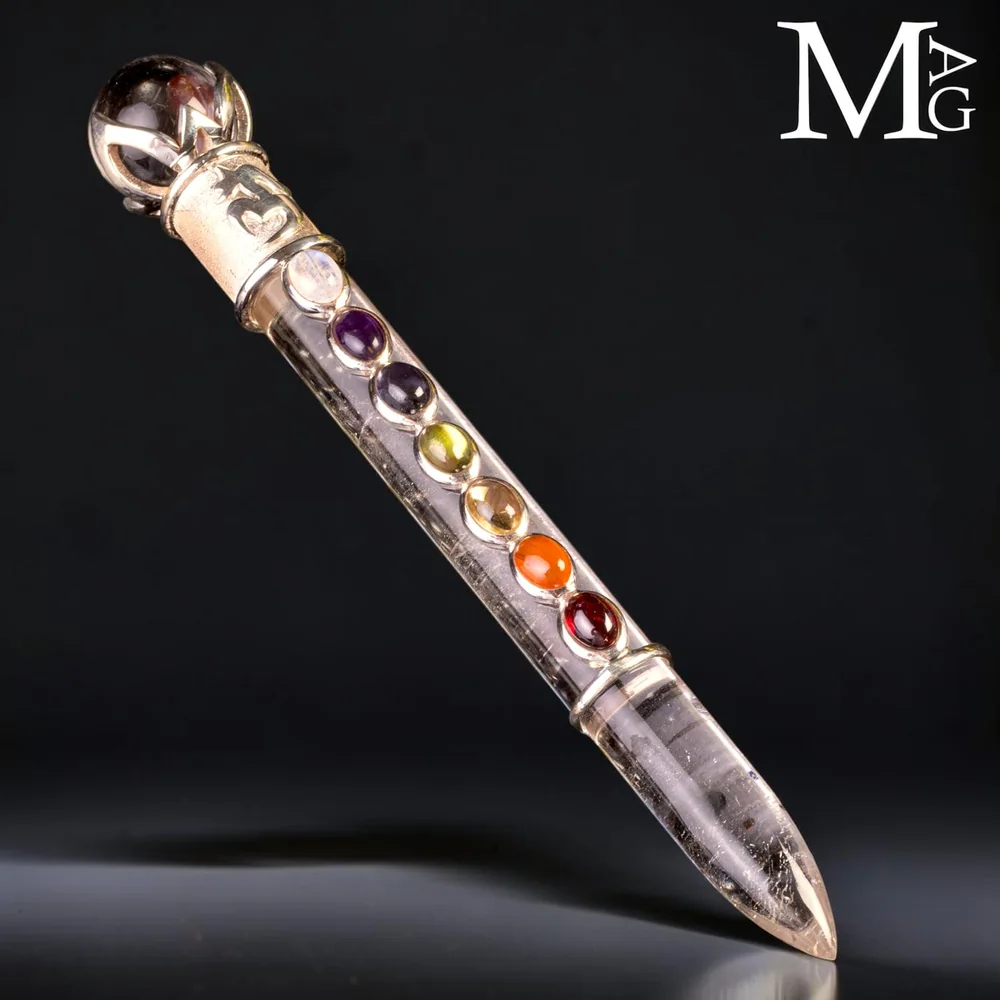
JLH40
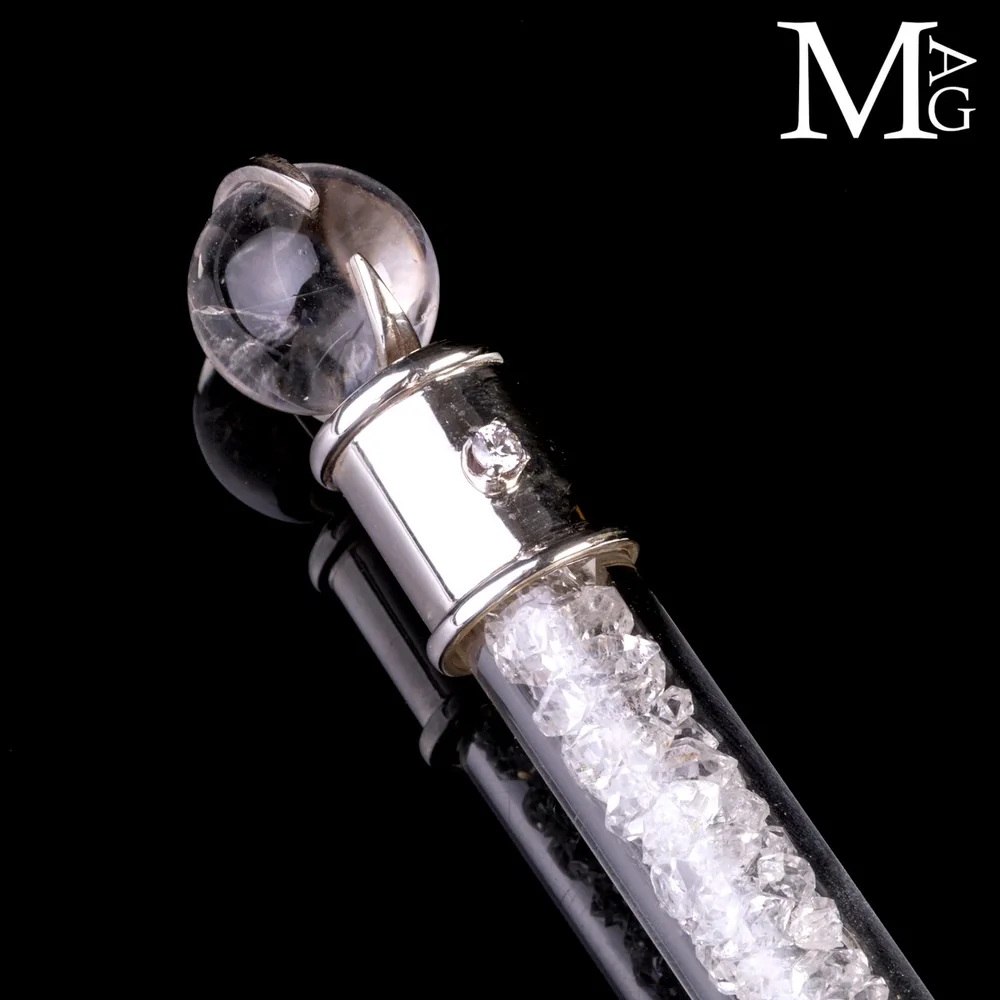
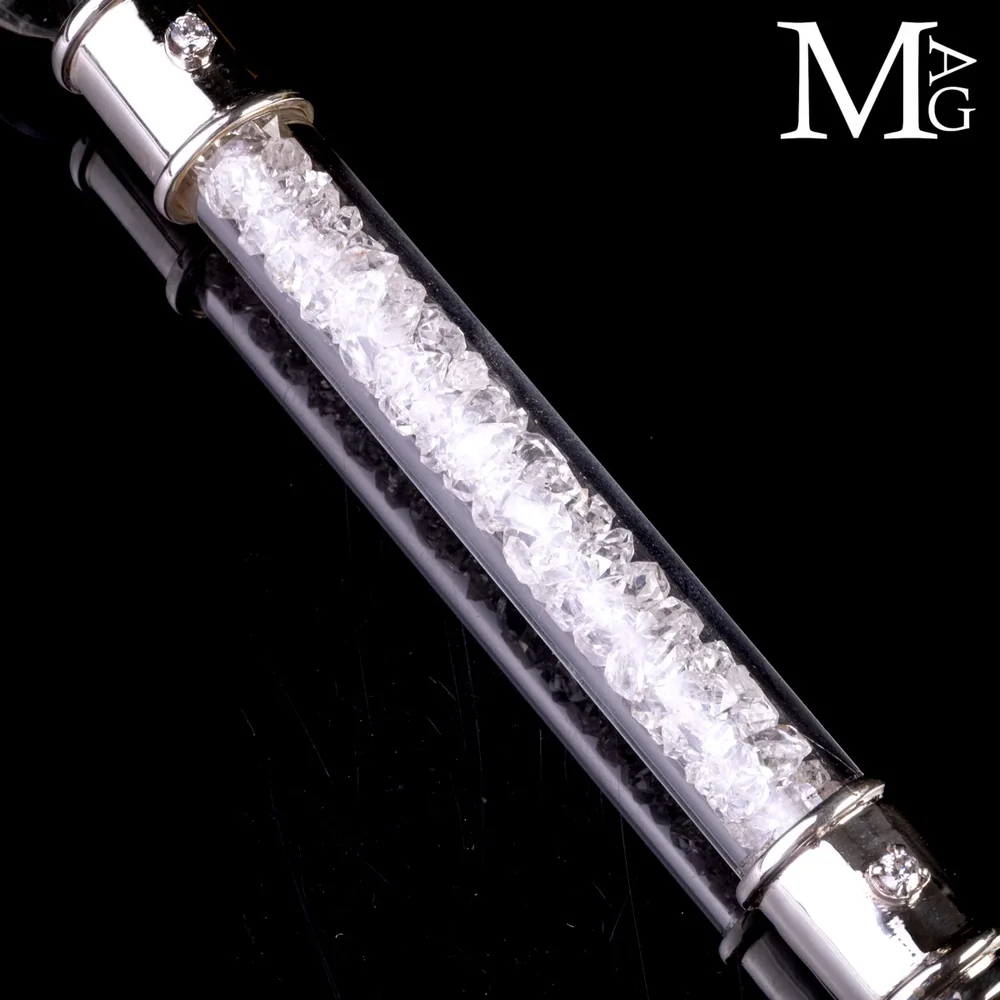
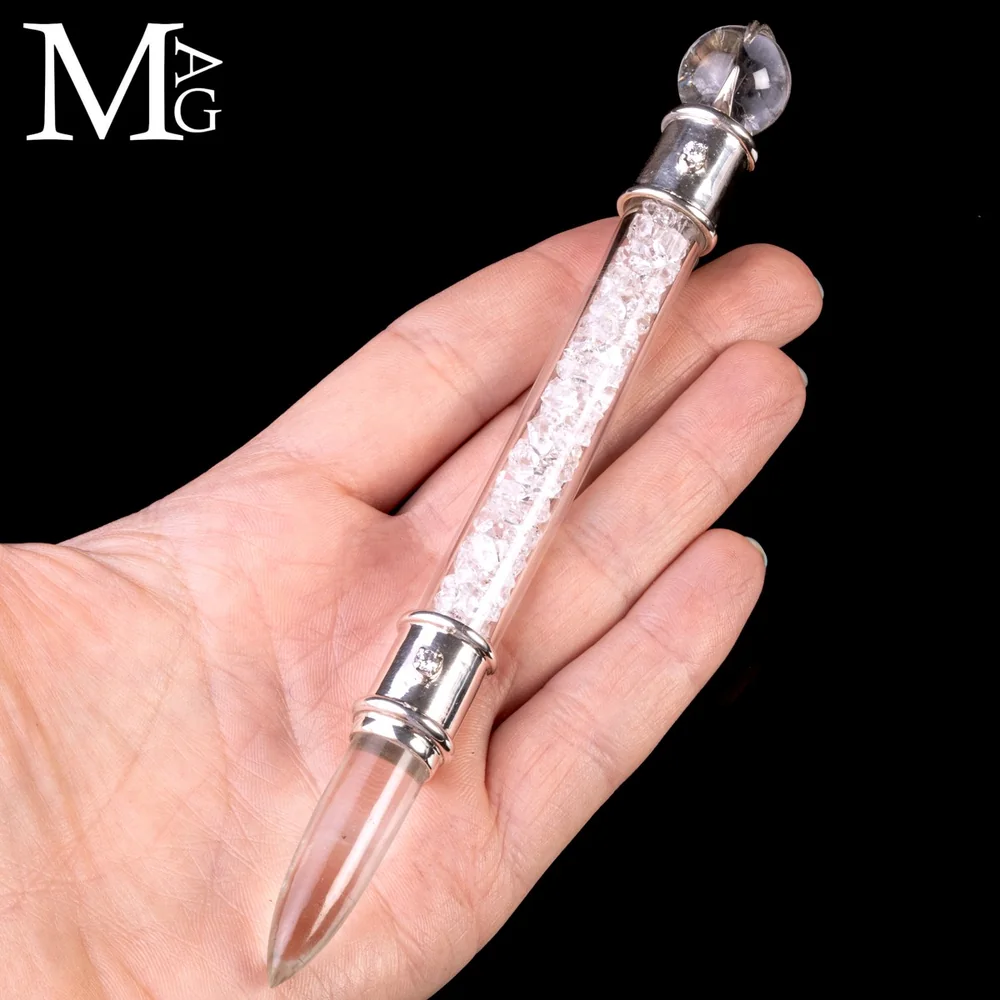
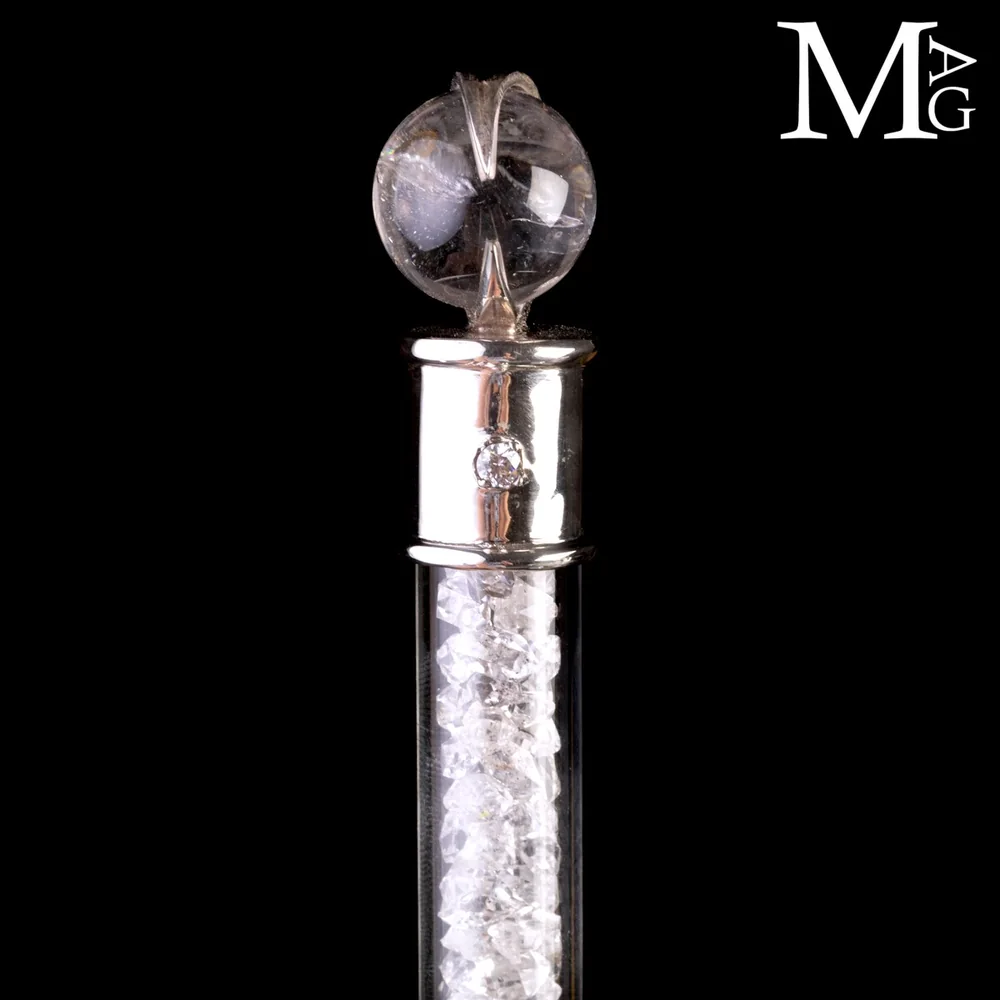
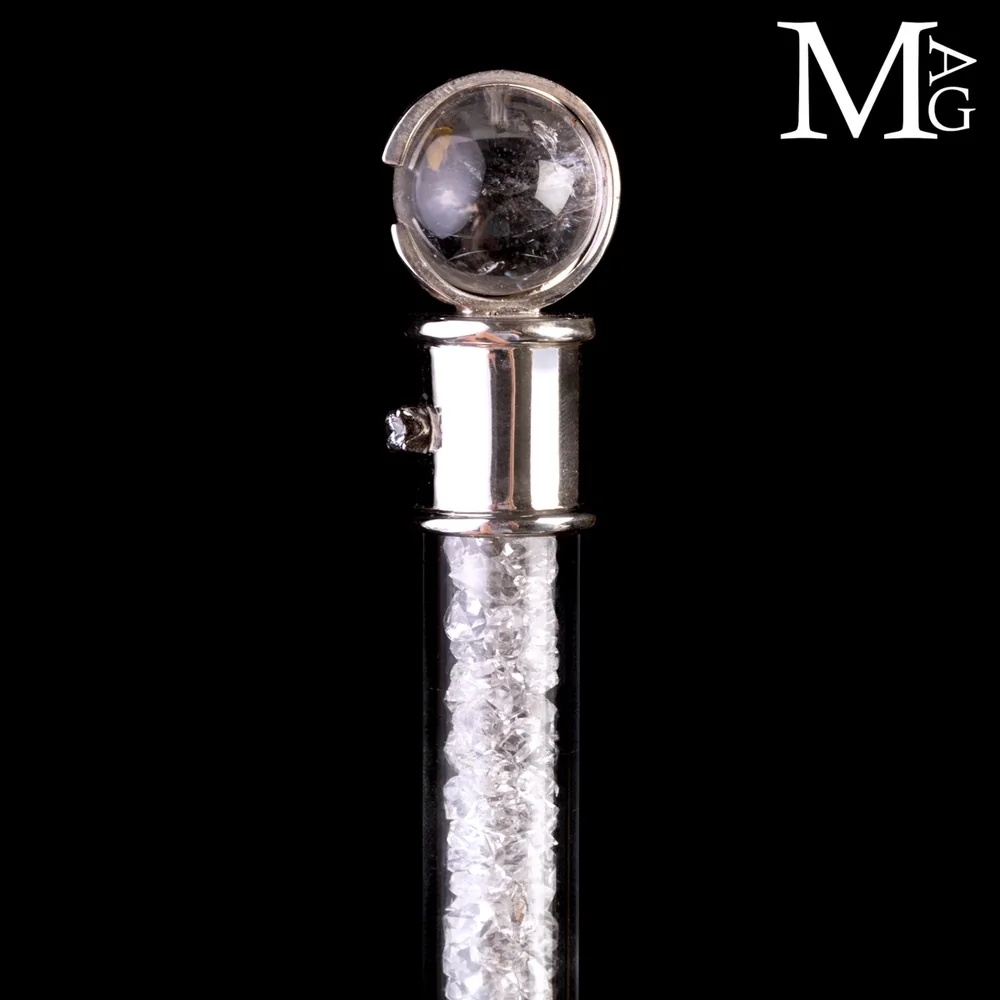
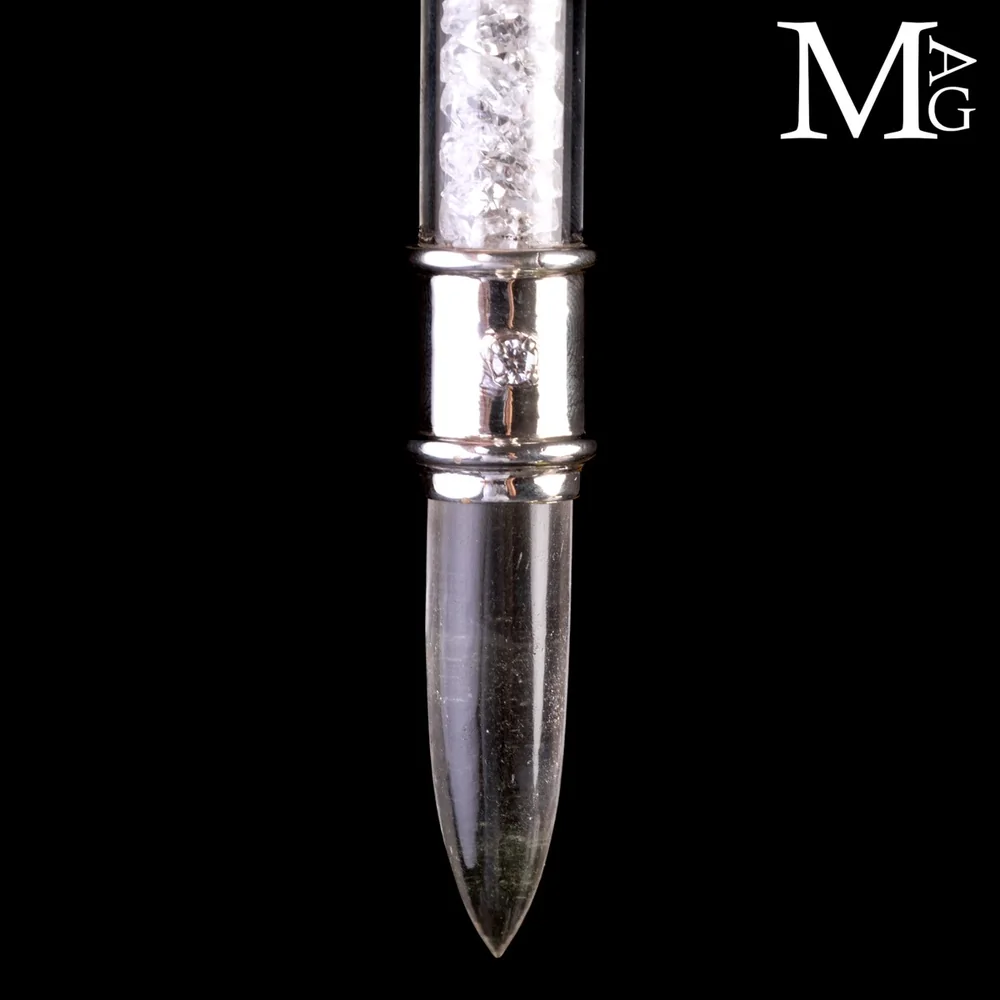
Original photographs supplied by Mineral Art Gallery; branding and details preserved.
A divination pendulum is a simple object: a small weight, often pointed, suspended from a thread or chain. It can be made of quartz, amethyst, metal, wood or composite materials. The simplicity of its form contrasts with the complexity of the interpretations people have attributed to it. In contemporary esoteric contexts, the pendulum is used for symbolic questions, introspective practices or forms of radiesthesia; in other contexts, it serves as a demonstration object for understanding movement and the influence of involuntary gestures.
Dowsing with rods has been documented in Europe for centuries and is also described in works connected with the search for minerals, including Georgius Agricola's De re metallica, published in 1556. In later periods, the use of the pendulum for various kinds of questions and searches became widespread. The term “radiesthesia” belongs to a more recent tradition. It should therefore not be claimed that all modern quartz pendulums descend directly from a single ancient ritual.
In a symbolic practice, the thread is held between the fingers and the weight is left free to swing. Some schools associate one direction of movement with “yes” and another with “no”, or use charts containing letters, numbers or symbols. There is no universal convention: the meaning of each movement is established by the practitioner. Many ornamental pendulums are distinguished by the shape of their point, the transparency of the crystal and the small stones set along their metal structures.
For a non-predictive contemplative use, it is possible to observe the swinging and reflect on how posture and attention influence movement. This is an interesting exercise in observation: it should not be turned into a reliable procedure for diagnosing illnesses, deciding on treatments, checking food safety or determining future events.
In the nineteenth century, French chemist Michel-Eugène Chevreul studied the movements of hand-held pendulums, observing the role of small involuntary gestures. Today, this phenomenon is generally explained through the ideomotor effect: expectations, attention and minute muscular movements can produce oscillations that the person does not perceive as voluntary. Contemporary experimental studies have examined how pendulum length and finger movement influence the swinging.
This explanation does not erase the subjective value that a ritual may hold for an individual, but it prevents pendulum responses from being presented as objective knowledge, proven paranormal abilities or tools for medical assessment.
Crystallomancy, or scrying, differs from pendulum use: it employs spheres, mirrors or reflective surfaces as aids to vision or symbolic interpretation. In the history of European esotericism, some famous examples are associated with the sixteenth century and the figure of John Dee. Here too, the practice should be understood within its own historical and cultural context. A crystal sphere is first and foremost a worked object capable of refracting and distorting surrounding images; the meaning attributed to contemplation belongs to the person using it.
The space dedicated to divination within Micromutazioni offers an encounter with a world of symbols, pendulums and ritual objects in a tangible setting, alongside crystals and natural stone jewellery. Visitors can observe differences between materials, shapes and working techniques. The studio offers symbolic objects and tools, not divination readings, consultations or sessions.
The Mineral Art Gallery catalogue includes a category dedicated to pendulums made from crystal and natural gemstones.
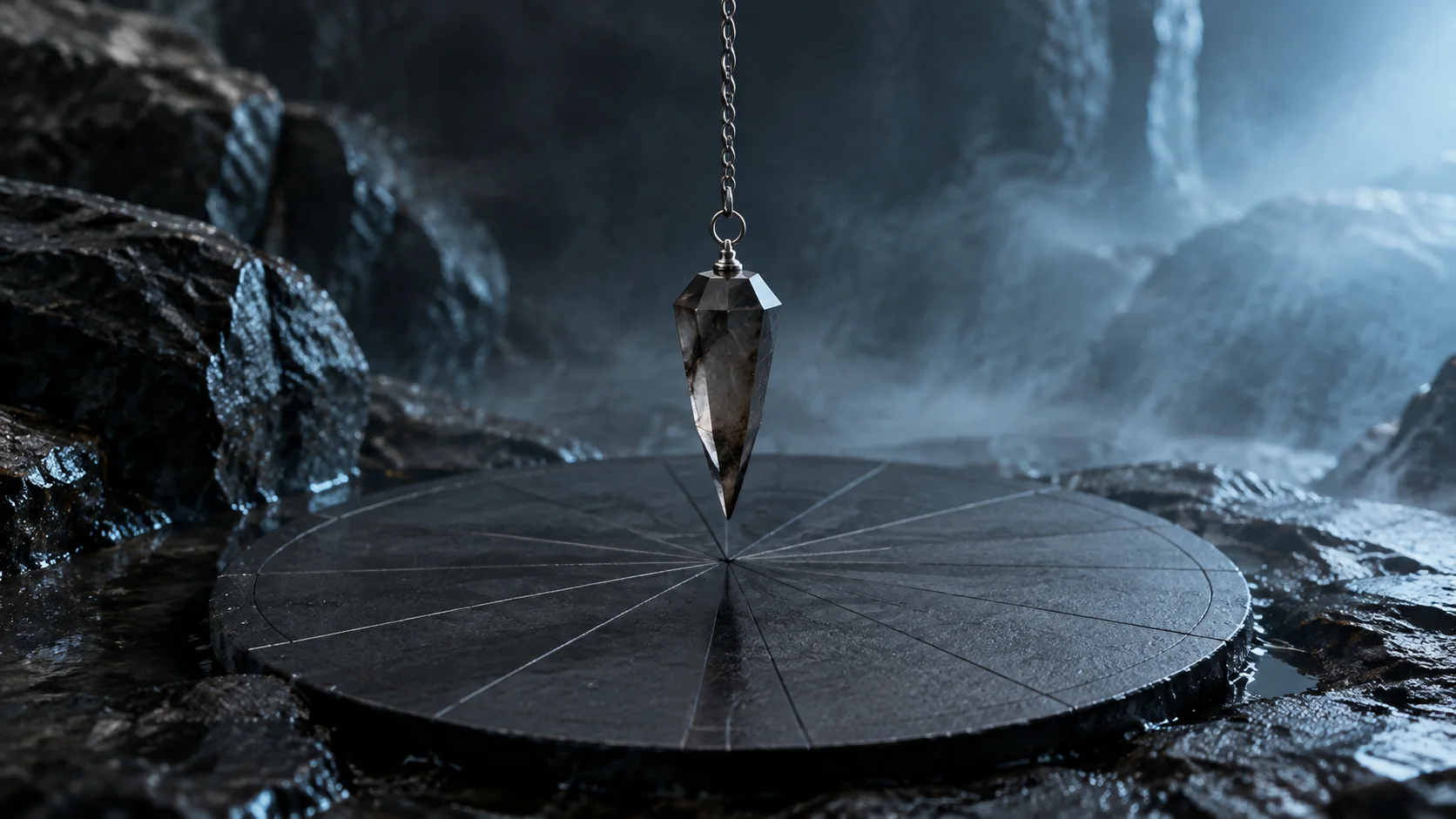
A weight suspended from a thread or chain swings; the user associates certain movements with “yes”, “no” or answers on a chart. Dowsing is documented in European mining around 1500, while pendulum radiesthesia developed mainly in the 20th century. Initial calibration establishes a personal convention, not proof of truth.
AI-generated editorial images: they illustrate the materials, rather than documenting authentic artefacts or rituals.
There is no need to attribute physical powers to a crystal to understand its presence in a ritual. An object can mark a different pace of time, signal an intention, help recall a commitment or become the centre of a personal composition. Some choose a stone for its colour and keep it in view during meditation; others prefer a sphere, point or cluster that reflects light differently each time it is observed. The practice can remain understated, private and non-medicalised.
Observing the crystal. Choose a clean, safe object, sit comfortably and observe it for a few minutes. Look at the crystal faces, transparent areas, shape and changes in the light. When your attention wanders, bring it back to your breathing. Do not seek a measurable result or an “energy signal”.
Intention ritual. A stone can be associated with a word or a personal commitment, such as paying more attention to a relationship or making time for a break. The intention is the person's choice, not a biological property transferred by the mineral.
Arranging stones. Organising several minerals in a small group can be an exercise in aesthetics and concentration. If they are arranged according to symbolic geometries or the chakra system, the meaning belongs to the chosen tradition. The shape does not demonstrate the existence of therapeutic energy fields.
Using the wand. The wand can be held and observed, or moved slowly through space as part of a ritual. Points are hard objects: do not apply pressure to sensitive skin or bring them near eyes, the mouth or wounds.
The word “crystal” encompasses materials with very different levels of resistance. Quartz has a hardness of 7, while gypsum/selenite is very soft and easily scratched. Amethyst can fade with intense, prolonged exposure to light; some opals are sensitive to dehydration and thermal shock; porous or treated stones can react to water. Avoid treating salt-water baths or exposure to the sun to “recharge” crystals as a universal rule: these are ritual customs that can damage some materials.
For cleaning, begin with the most conservative approach: gently remove dust with a soft, dry brush. For more thorough cleaning, always check the species and any settings, treatments or glued parts. A wand with a glass cylinder, silver and crystals inside requires particular caution: do not immerse it indiscriminately. Avoid impacts, extreme temperatures, harsh cleaning agents and improper use of ultrasonic devices.
Some minerals contain potentially toxic elements or compounds. Ingesting powders, leaving unidentified minerals in water intended for drinking or using them in homemade preparations can pose risks. Some materials are soft, soluble, porous or sensitive to acids. This page does not recommend elixirs, stone-infused drinking water, ingestion or medical applications of mineral powders.
The composition and many physical properties of minerals are verifiable. Quartz has documented optical effects, crystal structure and piezoelectric properties. These phenomena are not evidence of energies capable of healing the body. The idea that a gemstone can “rebalance” a chakra, treat anxiety or prevent illness currently lacks robust scientific evidence. Similarly, according to the National Center for Complementary and Integrative Health, studies of Reiki have not clearly demonstrated effectiveness for specific health purposes, and the invisible energies proposed as its mechanism have not been demonstrated.
Research on meditation, by contrast, concerns psychological and contemplative techniques studied in different settings. If someone meditates while holding quartz, any results should not automatically be attributed to the stone. Ritual use can remain a cultural or personal matter, not a healthcare prescription.
The distance between a gemstone's symbolic meaning and its geological nature is not a problem to be solved by choosing only one version. It is an opportunity to discover two stories at once. A crystal forms slowly within the Earth, then encounters the hands of a craftsperson, the gaze of a collector and, sometimes, a spiritual narrative. We can admire all these dimensions, provided we know how to distinguish them.
“The information on crystal healing, Reiki, chakras and divination is historical, cultural and spiritual in nature. It does not constitute medical advice and does not replace diagnosis or healthcare treatment.”
Cleaning removes dust, fingerprints and residue. Cleansing and charging, by contrast, are personal or spiritual rituals: moonlight, sound, visualisation and other practices can hold meaning without changing any supposed measurable energy.
The practical concern is to prevent a ritual from damaging the material. Water, salt, sunlight and heat are not suitable for everything: when you do not know the stone, its treatment or its setting, begin with a soft, dry cloth and methods that involve no contact.
Selenite and other sensitive materials can be damaged; salt and moisture can scratch, corrode or penetrate fractures. “Natural” does not mean water-resistant.
Amethyst, fluorite and other gems can fade; sudden temperature changes can cause fractures. A moonlight ritual, meanwhile, does not require prolonged exposure to sunlight.
Do not cut, grind or drill unknown minerals at home. Silica, fibres and metals in the dust can be hazardous to inhale.
Keep hard and soft materials separate, avoid drops, and keep points or small pieces away from children and animals. For mounted jewellery, adhesives, threads and metals also matter.
A crystal may pass through mining, intermediaries, cutting, export and retail before reaching a table. Environmental damage, dangerous working conditions and exploitation have been documented in some supply chains; there is no universal certification that automatically makes a crystal “ethical”.
Asking about provenance and treatments does not spoil the poetry: it reconnects the object with reality. Be wary of absolute promises without documentation, and remember that “natural” does not mean sustainable, just as “synthetic” does not simply mean fake.
It is a collection of contemporary practices that attribute symbolic or spiritual meaning to minerals and use them during meditation and personal rituals. The therapeutic properties attributed to crystals have not been scientifically demonstrated.
A crystal has an ordered internal structure; a gemstone is a material selected for its beauty, durability and ornamental use. A gemstone can be a crystalline mineral, but also a rock or an organic material, such as lapis lazuli or amber.
In Indian spiritual traditions, chakras form part of different representations of the subtle body. The widespread contemporary system of seven rainbow colours and associated gemstones derives from more recent reinterpretations and is not a single, unchanged map from antiquity.
It is a spiritual method that originated in early twentieth-century Japan, commonly associated with Mikao Usui. Some practitioners combine it with crystals, but crystals are not a compulsory component of Reiki. It should not be regarded as a substitute for medical care.
In contemporary meditative practices, the wand can be held and symbolically oriented in space. The sphere is often associated with the diffusion of energy, the point with direction; these are ritual meanings, not proven therapeutic phenomena.
It is an object suspended from a chain, traditionally used in divination and radiesthesia rituals. Its movement can be explained by the ideomotor effect, meaning minute, involuntary muscular movements. It is not a reliable method for diagnosis, predictions or healthcare decisions.
No. Different materials react differently, and some may deteriorate. Selenite/gypsum, glued jewellery, assembled objects and some treated stones require particular caution. The appropriate cleaning method should be checked for each species.
Yes. The Micromutazioni studio, at Via Broggia 14 in Naples, presents a selection of crystals, minerals and natural stone jewellery, as well as a space dedicated to the world of divination. The availability of individual objects may vary, so contacting the studio before a visit for a specific item is recommended.
Micromutazioni offers opportunities to discover crystals through the physical studio experience and its cultural features. Mineral Art Gallery provides a specialist online catalogue of minerals, gemstones, jewellery and collectible objects. Some links on this page lead to relevant Mineral Art Gallery collections.
There is no robust evidence that stones and crystals cure diseases or balance chakras as physical effects. Their value can be aesthetic, historical, symbolic or personal. For health matters, it is important to consult qualified healthcare professionals.
MINERAL ART GALLERY
Micromutazioni is not only piercing: in our studio in Via Broggia, Naples, you will find a wide selection of minerals, rare and unusual gems, natural stones and silver jewellery set with stones. Come and see them in person, one by one.
If you are not in Naples, the whole selection is waiting for you on Mineral Art Gallery, the online shop of the Micromutazioni project: collector minerals, gems and silver jewellery shipped across Europe.
It can hold an immense geological history, the labour of those who mined and worked it, a personal memory or the time spent in meditation. Make room for symbolism without entrusting your health to it: these practices do not replace diagnosis, psychotherapy or medical care. The rest — beauty, listening, doubt and imagination — can remain wonderfully open.
Back to the eight chapters