01
The Body as a Territory of Expression
The human body is one of the oldest territories of cultural expression. Long before the invention of photography and fashion as we know it today, human beings used appearance to communicate identity, belonging, beauty, social status, and personal transformation. Adornments, pigments, tattoos, scarification, and body piercings are all part of this enduring history. Across different eras and societies, piercing the skin to insert an ornament has held a variety of meanings: a rite of passage, decoration, a symbol of prestige, a spiritual practice, a family tradition, or an individual choice.
Contemporary body piercing inherits a portion of this vast legacy. Today, a small nose ring, a titanium labret, a Helix jewelry piece, or a curated ear piercing setup can be simple stylistic statements. Yet, behind these seemingly subtle adornments lies a history spanning millennia, continents, and cultures. The Body Piercing Atlas was created to explore this history and, above all, to navigate the complex world of anatomical placements, professional terminology, techniques, and jewelry.
From the ear to the nose, from the lips to the tongue, from the navel to surface piercings, all the way to the rarest body modification setups, each chapter of the Atlas explores a facet of this language. Because a piercing is not merely a hole, nor is it just the jewelry worn through it: it is the intersection of anatomy, matter, culture, and aesthetic choice.
02
A History Spanning Thousands of Years
The Ancient Origins of Body Modification
Determining exactly when humans began practicing body piercing is extremely difficult. Skin rarely survives in archaeological records, and many ornaments recovered from burial sites do not allow us to identify with certainty how they were worn. However, there is ancient evidence of earlobe piercing. Ötzi the Iceman, who lived over five thousand years ago, had pierced and stretched earlobes—compelling proof of the antiquity of this practice.
Body adornments were well known in the ancient Near East, in Egypt, and across many other regions of the world. Earrings, rings, metallic elements, and jewelry testify to the importance of bodily decoration, even if linking an archaeological artifact to a precise anatomical location is not always possible. In numerous African, Asian, Oceanic, and Indigenous American communities, distinct forms of body piercing have carried specific social and cultural meanings.
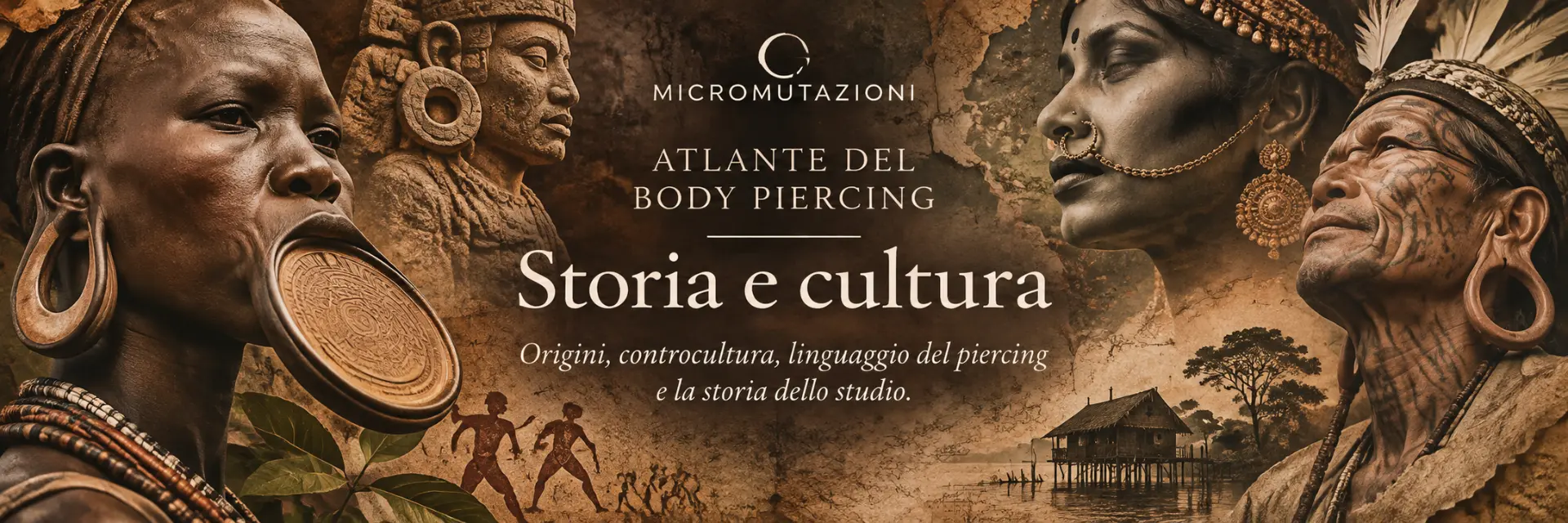
Lip plates, for instance, are documented among certain East African communities, including the Mursi and Suri people of Ethiopia. These ornaments belong to complex local traditions that cannot be reduced to a mere precursor of modern Western trends. Similarly, the nasal, ear, and lip adornments of diverse indigenous populations belong to autonomous traditions that developed in distinct historical contexts. Discussing the origins of piercing therefore means acknowledging a plurality of histories, rather than fabricating a single evolutionary timeline.
Modern Piercing: Counterculture and Professionalization
In the twentieth-century Western world, earlobe piercing was already widely accepted, whereas perforations on other parts of the body remained less common and were often associated with circles far removed from mainstream culture. A pivotal phase in the professionalization of modern body piercing took shape in the United States during the 1970s. Figures like Jim Ward and the professionals associated with Gauntlet helped transform what had been a scattered practice into a specialized industry, introducing jewelry engineered for specific anatomies and placing an increasing emphasis on sterile procedures. Leather communities, fetish subcultures, and underground scenes also played a significant role.
The punk movement of the 1970s and 1980s helped popularize piercing as a disruptive visual language. Safety pins, metal hardware, and unconventional ornaments became recognizable hallmarks of an aesthetic that challenged conventional codes of appearance. The safety pin holds a unique symbolic power: an everyday object repurposed into a statement of identity. However, it does not mark the origin of the modern professional piercer, nor does it represent suitable jewelry for a fresh piercing.
Throughout the 1990s, piercing gained widespread visibility through music, fashion, television, dedicated magazines, and a new wave of professional studios. Eyebrow, lip, nose, tongue, and navel piercings began appearing with increasing frequency in popular culture. Body piercing gradually crossed over into contemporary fashion without losing its ties to alternative roots.
From the Alternative Scene to Fine Jewelry
One of the most significant evolutions concerns the jewelry itself. Alongside the essential forms of the captive bead ring, the barbell, and the labret, the industry has embraced modular systems, advanced closure mechanisms, precision craftsmanship, certified metals with technical documentation, and designs inspired by fine traditional jewelry. Today, a piercing can be expressed through a minimal titanium hoop, a solid gold ornament, a diamond setting, a gemstone cluster, or a plug carved from natural stone.
The ear has evolved into a canvas for curation. Helix, conch, tragus, daith, and lobe piercings can be elevated with curated combinations where scale, color, symmetry, and proportion take center stage. This is the language of the curated ear: a collection of piercings designed as a personal fine jewelry composition. Contemporary piercing no longer belongs to a single subculture; it is worn across generations and diverse sensibilities, spanning from everyday street style to the most sophisticated expressions of luxury.
03
The International Language of Piercing
Anyone entering a studio or buying jewelry online encounters English names like Helix, Tragus, Conch, Septum, Labret, Barbell, Clicker, Plug and Tunnel. However, there is no perfectly uniform nomenclature. Labret can refer to both a spot on the lip and a component with a flat base. Industrial describes two connected piercings. Snake Bites indicates a lip piercing configuration. Curated Ear is an aesthetic project. Gauge originally designates a measurement of thickness, but in retail it is also used in the world of stretching. The Atlas retains international terminology to make these differences understandable and to facilitate category searches.
04
Micromutazioni: a story that began in 1999
The story of Micromutazioni unfolded during a pivotal era for body piercing in Italy. In the late 1990s, piercing was undergoing a profound transformation: once an expressive medium primarily associated with alternative cultures, it was becoming increasingly present in everyday life. Micromutazioni was founded in Naples in 1999, and its professional origins in piercing are tied to the studio on Via Enrico Pessina.
Throughout this journey, the studio has explored different forms and sensibilities, from essential metal structures to contemporary jewelry in titanium, gold and gemstones. The Atlas tells this story through the understanding of anatomies, traditions and terminology that have built the discipline, keeping the studio’s practical experience at its center.
05
An Ever-Evolving Atlas
The language of piercing is not static. New systems, aesthetic configurations, and commercial names continue to enrich the industry. That is why the Body Piercing Atlas is an open editorial project. Each placement can be explored in depth with dedicated entries, photographs, anatomical and historical explanations, information on materials, and links between related topics. The goal is to offer a valuable resource for both the general public and professionals, where culture, anatomy, and jewelry meet. A small ornament can tell a story far larger than its own diameter.
Micromutazioni — Naples, since 1999.